You are viewing 1 of your 1 free articles
The MP calling for an Ofsted for temporary accommodation
Before she became an MP in 1997, Dame Siobhain McDonagh built her career in social housing. She is still fighting for housing, now as chair of the APPG for Households in Temporary Accommodation. She speaks to Stephen Delahunty. Photography by Alicia Canter


 Dame Siobhain McDonagh built her career in social housing. Now as chair of the APPG for Households in Temporary Accommodation, she speaks to Stephen Delahunty #UKhousing
Dame Siobhain McDonagh greets Inside Housing in a busy corner room on the first floor of Portcullis House that overlooks Westminster Bridge across the River Thames.
This is familiar territory for Dame Siobhan, who has been a Labour MP for 28 years. She escorts me and a photographer around the first floor of the wood-panelled building where 200 MPs have their parliamentary office space, and into a committee room named after Joseph Grimond, the leader of the Liberal Party from 1956 to 1967. A long-term supporter of Scottish home rule, he successfully advocated for his party to support the abolition of Britain’s nuclear arsenal. However, Scottish devolution and Labour’s commitment to nuclear weapons are not on today’s agenda.
Around a week before Dame Siobhain agreed to meet us, the MP for Mitcham and Morden had put forward an amendment to the Children’s Wellbeing and Schools Bill that will require councils to inform schools and GPs when families with children are placed in temporary accommodation.
Read more


“I [haven’t been] able to get that accepted by the government yet, but we do have a commitment that they will look into it and do something in that regard,” says Dame Siobhain.
The need for regulation
One day after the interview, the cross-party Housing, Communities and Local Government Committee made exactly that recommendation.
It also called for mandatory inspections before housing is first used as temporary accommodation. This is in addition to a new requirement for local authorities to notify a host council before it makes an out-of-area placement.
So while her amendment may not have been included this time, it’s a signal of the detailed and serious approach Dame Siobhain takes in her role as chair of the All-Party Parliamentary Group (APPG) for Households in Temporary Accommodation.
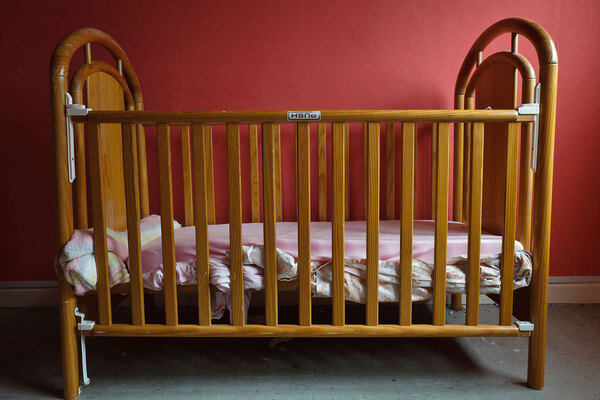
She has already been involved in some other changes. MPs on the APPG were among those campaigning for the mandatory provision of cots for families in temporary accommodation with children under two. In March 2024, the previous government updated the Homelessness Code of Guidance for Local Authorities to require cots be provided.
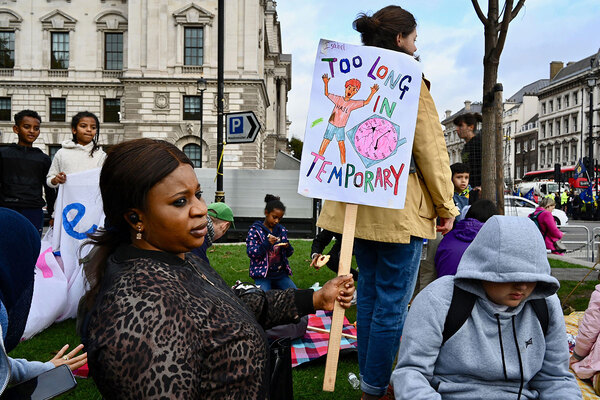
“The pressure is ramping up,” she says. Her ultimate aim is for temporary accommodation to be overseen by an Ofsted-style regulator, to drive standards up.
Dame Siobhain, who was made a dame in the 2024 New Year Honours, says: “I think, for a long time, the concern has been that if it is more regulated, then we will get less of it.
“But I think you need independent regulation to ensure councils are adhering to a code of guidance.”
The MP understands the additional pressure under which this might put councils at a time when homelessness services are struggling, and spending on temporary accommodation costs the taxpayer more than £2bn a year. Earlier this year, Inside Housing and the i newspaper joined forces to find out how the money is being used.
The investigation followed the news that two-thirds of councils are at risk of being unable to set a balanced housing budget by the next general election. This is because of capped incomes, soaring costs and frequent policy changes since 2010.
This funding crisis is why Inside Housing and Homeless Link have launched a new campaign, Reset Homelessness, which calls for a systemic review of homelessness funding in England.
“Ultimately, the only way you’re going to sort the housing crisis out, and sort the temporary accommodation crisis out, is by building more homes”
Despite the additional costs that might come with a new regulator, Dame Siobhain says: “I think we would see a big improvement in ensuring that receiving boroughs are informed that they’re getting families, of ensuring that there are cots in temporary accommodation, of making sure that councils are fully aware just of what they are putting people in.
“I think, if you had an independent regulator, there would be much more pressure to adhere to the rules, and there would be pressure on the government to make sure that those rules were funded.”
Dame Siobhain has experienced some of the issues facing the sector first-hand, as she worked in several housing-related roles before she became an MP in Labour’s landslide victory in 1997.
After graduating with a politics degree from the University of Essex, she worked as a clerical officer at the Department of Health and Social Security on an early idea similar to Universal Credit, then became a receptionist at Wandsworth’s homeless persons unit from 1984 to 1986, and a housing advisor at the council from 1986 to 1988.
At this time, Margaret Thatcher’s government spearheaded major reforms of the housing sector with the Housing Act 1988.
“I remember thinking: How is this going to work? We’re just going to pay private landlords the rent through the benefit system. I thought, this is going to go wrong eventually, isn’t it? I never thought that it would take another 40 years to go so wrong, but it did,” she recalls.
Dame Siobhain reflects that, before the 1988 act, the private rented sector was regulated, rents were capped and tenants commonly had lifetime tenancies. The act swept these regulations away, laying the groundwork for the private rented sector we have today, and the subsequent explosion in temporary accommodation.
She also worked as a development manager for Battersea Churches and Chelsea Housing Trust from 1988 to 1997, served as a councillor in Merton until 1998 and chaired its housing committee between 1990 and 1995.
In this position, she played a key role in the rebuilding of the Phipps Bridge Estate. The estate was originally part of a pre-war slum clearance programme by the Municipal Borough of Mitcham, which later became part of the London Borough of Merton.
She says: “We had one high-rise block on the estate. Half the children on the at-risk register of Merton Council were in that block. It was the Wild West, and nobody who had any choice wanted to take an offer [of a flat on the estate].
“It seems amazing now, [but] we had a hard-to-let policy, where we would let it out to people who were prepared to go and live in it,” she says.
Dame Siobhain, who also chairs the parliamentary Labour Party women’s committee, tells Inside Housing that Bridget Phillipson, the education secretary, came to one of the group’s meetings to discuss the impact of temporary accommodation.
“One of the first things [Ms Phillipson] talked about was the impact of temporary accommodation on children, on their welfare and their health. So it is a significant issue, and people are talking about it.”
This, she believes, shows that the issue is on the cabinet’s agenda. Ms Phillipson’s concern is not unwarranted, as quite a few recent reports found that the number of children who have died in temporary accommodation has risen to 80.
Between 2019 and 2024, 74 children died unexpectedly in situations where temporary accommodation was a contributing factor. Of these, 58 were under the age of one.
Prioritising housebuilding
Children living in temporary accommodation and those forced to move house regularly achieve worse GCSE results, according to analysis by the Children’s Commissioner for England.
Speaking to Inside Housing about the findings of our joint investigation with the i, Dr Amaran Uthayakumar-Cumarasamy, an NHS paediatrician who works with Medact, a campaign group for health justice, said: “Undernutrition, respiratory illness and poor mental health are symptomatic of the failures of an unjust housing system.
“The use of temporary accommodation paints an especially bleak picture for both the short and long-term damage done to the physical, mental and social health of children and young people.”
Dame Siobhain, who also commented on the findings at the time, adds: “It’s a problem that has been growing for a long time, and there is a long list of housing issues to deal with. It is definitely on that list, but getting it to the top of that list is the real challenge.”
Regarding Labour’s other reforms, Dame Siobhain becomes excited when the discussion turns to the government’s target to build 1.5 million homes, and its planning and construction skills reforms.
“It shows we are serious about the challenges and are committed to creating the opportunities for councils and other parts of the sector to approach what is a huge crisis with more of a can-do attitude,” she says.
It is not clear how much of this new housing will be social rent, or how much development grant will be available.
Asked why housing policy is often framed as a battle between the Ministry of Housing, Communities and Local Government and the Treasury, Dame Siobhain says diplomatically: “I think the cabinet understands the significance of this issue, but there will always be some delay between talking about something and taking action.
“I think the recent announcement of £2bn more for social housing, at a time when the economy is under a great deal of pressure, and the government is under a great deal of pressure, is an indication that the will is there and the desire for building is there.
“We know that growth comes out of building more homes, because for every pound you spend, somebody moving into a new house gets curtains, gets carpet, furnishes a home. So we know that, on every level, it works.”
“The use of temporary accommodation paints an especially bleak picture for both the short and long-term damage done to the physical, mental and social health of children and young people”
In the run-up to the election, the Labour Party made a big deal of its housing ambitions, and it has tried to maintain that momentum over the past eight months. But how key does Dame Siobhain believe these policies will be to the party’s success next time around?
“It’s important for us and for our morale, because we want to build homes. If you’re an MP doing a weekly advice surgery, there’s no way you’re escaping the number of homeless families and those living in temporary accommodation,” she says.
“Hitting these targets is a win on all levels. The desire is certainly there; we have no problems getting MPs to turn up to our APPG meetings to discuss this issue, who turn up because they are desperate for a solution.”
After the chancellor’s Spring Statement, the Office for Budget Responsibility predicted that the government’s planning reforms could lead to net additions to the housing stock of around 1.3 million homes by 2030. This is a big jump, but lower than the government’s much-publicised 1.5 million homes target.
“I’ve shared many of the frustrations on the long-winded nature of the planning process [in my constituency], so the delivery target excites me, and that is coming with a step change in the atmosphere and attitude to building new homes,” Dame Siobhain says.
“Ultimately, there is only one solution. It’s not brain surgery. The only way you’re going to sort the housing crisis out, and sort the temporary accommodation crisis out, is by building more homes.”
Other Reset Homelessness articles
Inside the economics of temporary accommodation
Although temporary accommodation now costs the taxpayer more than £2bn a year, spending on this type of housing remains largely unexamined. Inside Housing and the i newspaper joined forces to find out how the money is being used. Stephen Delahunty, Peter Apps and Vicky Spratt report on the findings
Homeless, vulnerable, but not a priority
As local authorities struggle with the mounting numbers of people turning to them for homelessness help, many are being deemed ‘not priority need’, and left to fend for themselves. Katharine Swindells investigates
Reset Homelessness: ‘The system cannot continue as it is’
Inside Housing and Homeless Link’s new campaign, Reset Homelessness, calls for a systemic review of homelessness funding in England. But how has spending on the homelessness crisis gone so wrong? Jess McCabe reports
How to shift from crisis management to preventing homelessness
When you are in the middle of a crisis, how do you reinvent homelessness services to make them about prevention? As part of our Reset Homelessness campaign, Jess McCabe reports from a conference where the gap between good intentions and the capacity to change is palpable
The carousel of homeless funding as experienced by one Leeds service
What can the government learn about how to improve homelessness services from the funding and staffing problems of one frontline provider? As part of Inside Housing and Homeless Link’s Reset Homelessness campaign, Ella Jessel visits a service in Leeds to find out what needs to change
Sign up to our Best of In-Depth newsletter

We have recently relaunched our weekly Long Read newsletter as Best of In-Depth. The idea is to bring you a shorter selection of the very best analysis and comment we are publishing each week.
Already have an account? Click here to manage your newsletters.
Related stories