Who opened the window?
How do you know which eco-technologies will produce the best results when retrofitting social housing stock? Simple, place a family in an eco-refurbished house and monitor their every move. Anita Pati reports on a London pilot doing just that


Eco-refurbishment pilots are springing up all over the country as sustainability becomes an increasingly important consideration when planning affordable housing.
Social tenants and their families have agreed to act as guinea pigs, inhabiting eco-homes kitted out with cutting edge technology in order to test how much energy is used and to study their efficiency. Buildings can be monitored scrupulously - for instance, the £17 million retrofit for the future programme, run by the Technology Strategy Board, is remotely monitoring the temperature in each room of 86 housing projects every five minutes for the next two years.
But how effectively can human behaviour be monitored within these somewhat artificial contexts? Notting Hill Housing Trust has just completed its first exemplar eco-refurbishment project at 19 Sterndale Road, a six-bed Victorian property in west London. Over the next two years, the trust will, with its partners - Hammersmith & Fulham Council, United House and Baily Garner - test and monitor the energy savings and carbon dioxide reductions that various eco-innovations bring. This will all take place while tenants live in the house.
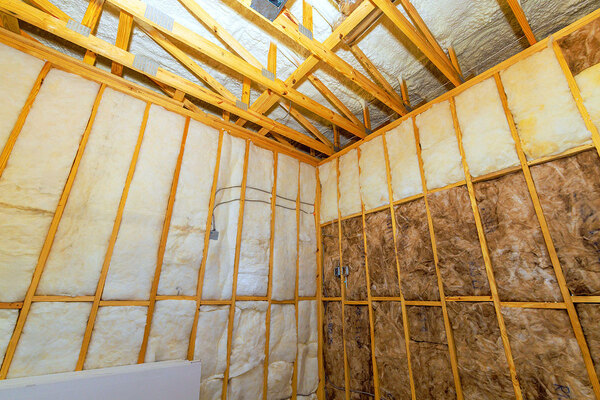
Baily Garner, the construction consultant who worked with Notting Hill, used specialist software to calculate that the eco-refurbishments would save tenants an annual £2,600 in energy bills, and cut carbon emissions at the property by 86 per cent, equivalent to 10,000kg carbon dioxide per year.
The tenants will be a family nominated by Hammersmith & Fulham Council, says Thomas Carroll, head of asset management at Notting Hill. Choosing the test faily did, however, provoke discussion between Notting Hill and the council. ‘Should we have a more eco-friendly family or a more “normal” one and just get the recommendation from Hammersmith & Fulham?’ were dilemmas the partners faced, says Mr Carroll. In the end, he says, ‘we felt that we didn’t want to skew our measurements by having an eco-friendly family in there.’
Andy Tookey, partner at Baily Garner, accepts that monitoring a nominated rather than a chosen family, ‘is more reflective of what you’ll get in real life - you can’t make everybody a green tenant’.
But he adds that despite maximising eco-efficiency in the house, he hopes the tenants will also change wasteful behaviour through the offer of an educational package including specialist workshops.
He also hopes the project will learn from the tenants’ behaviour - wasteful as well as careful.
‘We have lots of monitoring equipment in the house,’ he says. ‘Because if people are used to whacking up the heating system with the thermostat, living at 25 degrees in the house and controlling that by opening the windows, they’re not actually saving on energy use.’
Mr Tookey adds that, ‘all of the windows are wired up so the University of Brighton can actually look at the energy pattern and tell which windows are open and for how long’.
The family, which is in the process of being recruited, will be instructed on how to use the equipment. Any lessons learned on how they react to the home will be fed back to other eco-projects and to tenants nationally.
Mr Carroll says he thinks the costs involved are worth it: ‘We hope that this will improve how tenants use their homes. But it’s not just about the tenants’ use, it’s also monitoring the equipment and the building as well.’ He adds that the project is measuring non-tenant influenced factors, such as the air-tightness of the building.
Toby Jay, a project manager at architects and construction consultancy Hunters, says his practice does not monitor clients, mainly because of the costs. But while he says tenant monitoring could benefit individual schemes, he asks, ‘in a wider context, could you take the user characteristics from one scheme and apply it to another? I don’t think you could unless everybody has roughly the same jobs, working roughly the same hours in the same thermally performing units - that’s quite unlikely.’ Mr Jay adds that there is little value in industry software which uses a formula to calculate dwellings’ and clients’ carbon output. ‘You’d have to come up with some kind of standard average,’ he says.
Similarly, Nicholas Doyle, project director at Places for People, says expecting tenants to live in an energy-conscious way and to use eco-equipment correctly is misconceived. ‘You can’t fundamentally change human behaviour,’ he says. ‘People’s behaviour changes when it’s motivated by things that affect them directly.’
Energy displays are the only exception to this rule, he argues, because they ‘make a significant difference to people’s behaviour’ by showing directly how money is gobbled up. Places for People has conducted an experiment on several Ecohomes excellent-rated properties where there was a 10 to 18 per cent energy saving after using an energy display meter. This showed that tenant behaviour was more likely to change where there was an immediate and tangible cost implication. The most dramatic savings were achieved by cutting down on kettle and hairdryer use. In this project, both children and parents hassled each other over their respective domestic use after seeing the direct cost via the meter.
‘We have to build houses that need as little personal input as possible by the people living in them because there is so much variation in actions by individuals,’ Mr Doyle says.
He reserves his ire for the energy advice industry: ‘We seem to think we need an entire industry [energy advice] to tell people how to use the products of another industry [sustainable housing]. We shouldn’t have to have that anymore.
‘You have to do it again and again and again. Can you imagine having an iPod that required you to be retrained to use it every six months?
‘Why do we need that in housing when we don’t in any other industry? We wouldn’t build cars that required constant behavioural change by the people that used them - you’d think it crazy.’

How monitoring will be carried out at 19 Sterndale Road
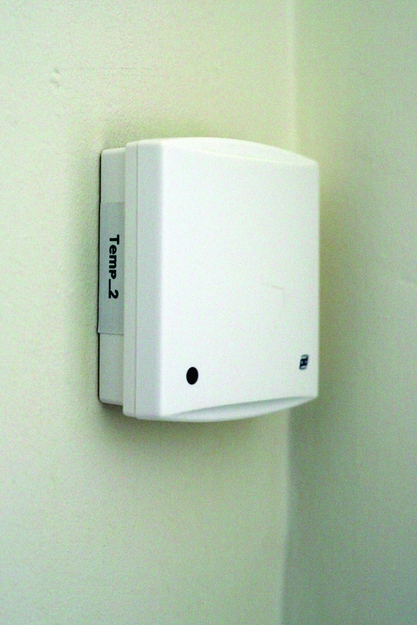
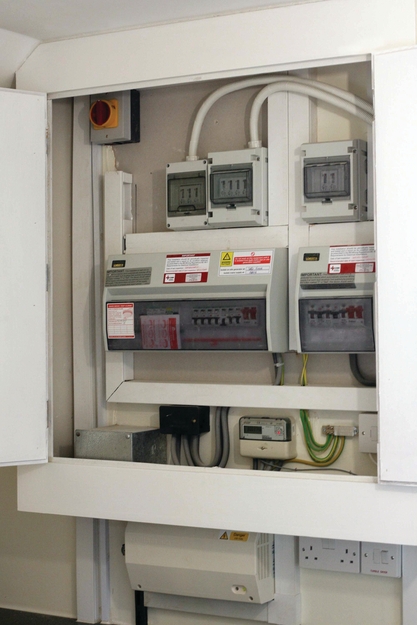
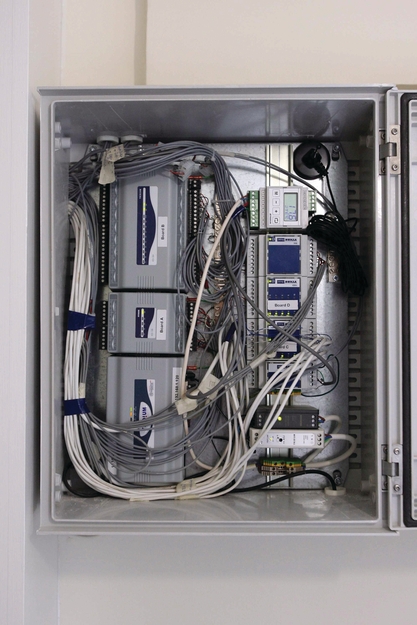
The monitoring part of the project will cost roughly £14,000 - 14 per cent of the house’s eco-refurbishment budget. Both tenant behaviour and building performance is being monitored. The Centre for Sustainability of the Built Environment at the University of Brighton is monitoring and analysing usage from build to occupancy. This includes measuring electricity and gas consumption, with the gas boiler and individual circuits measured separately so that living areas and kitchen areas can be monitored. The electrical input from photovoltaics will also be measured. In addition to this, the incoming water from the water mains, heat supplied by solar water, thermal performance of insulation materials, external climate monitoring of air temperature and window sensors, will all measure energy flow.
There will also be thermocouples embedded in the external and party walls which measure heat transfer through the walls, and thermometers that record external and internal temperatures. A post-occupancy survey with residents will be carried out to evaluate satisfaction.
Is the whole process worth the cost? Mr Tookey says: ‘Sterndale Road is our blank canvas to do some research and development - nobody in their right mind is going to go away and replicate Sterndale Road in their stock - they couldn’t afford it.
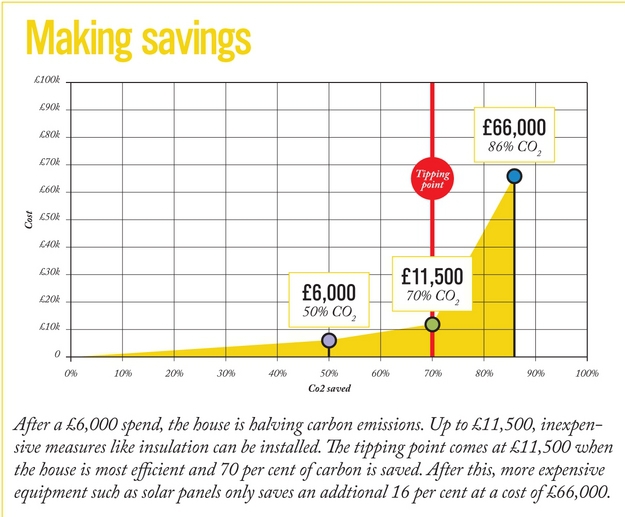
‘What we’ve found is that if you spend up to £6,000, you make a significant saving on your carbon dioxide reduction. After the monitoring, the team is hoping to come up with a table that shows how many kilograms of carbon are saved per pound invested.
Related stories