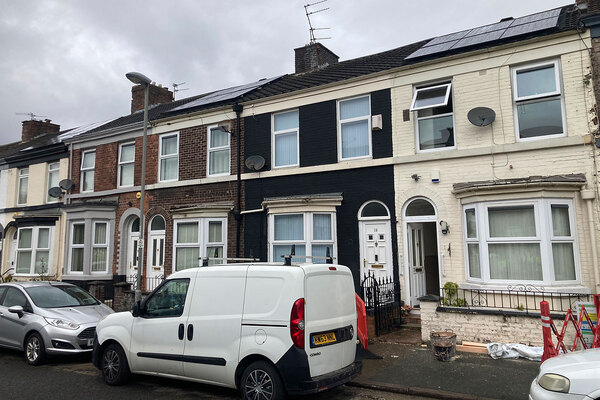
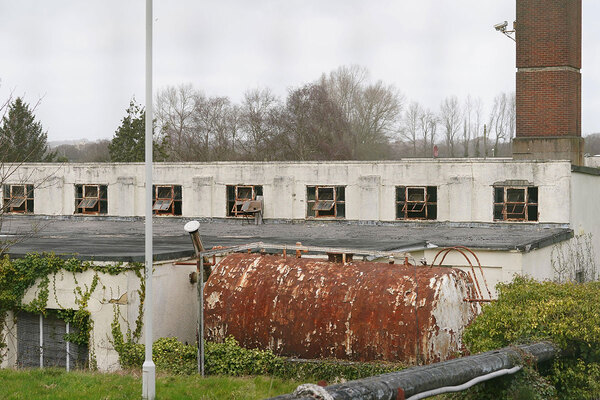
Will changes to the Treasury’s Green Book alter the face of housing delivery in England?
The Green Book – Treasury guidance on appraising programmes and projects – has been maligned in housing circles because of its perceived kiboshing of regeneration in the North. But June’s Spending Review promised no region would be left out in the future. Kate Callaghan reports. Illustration by Dominic McKenzie


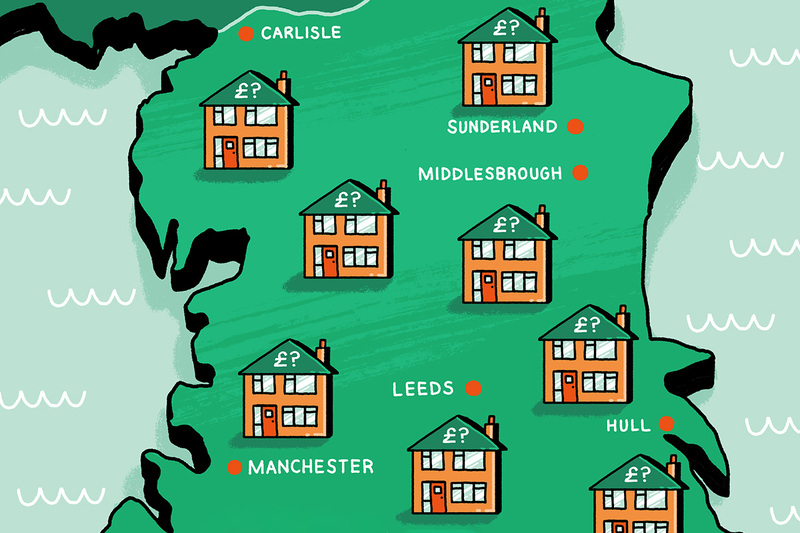 Will changes to the Treasury’s Green Book alter the face of housing delivery in England? #UKhousing
In June’s Spending Review, the government announced that the Treasury’s Green Book would be changing (again). For the uninitiated, this is potentially extremely significant because it impacts the methodology used to compare projects bidding for government investment, and consequently where the government allocates spending.
Chancellor Rachel Reeves promised that the new approach will support “place-based business cases” and ensure “no region has Treasury guidance wielded against them”. Many housing providers, particularly in the North of England, have long been lobbying for a change. They feel that the current framework has made it more difficult to gain funding for some projects, particularly regeneration schemes.
Are the changes as dramatic as they sound, however? In a joint investigation, Inside Housing and Social Housing have looked into these claims and whether they will rebalance spending in England.
Read more


Let’s start with what the Green Book is, and what it does and doesn’t do. At its most basic, it is a framework, issued by HM Treasury, for assessing the value for money of differing proposals for meeting government objectives. It is meant to support public servants in providing impartial and objective advice to decision-makers, such as ministers or councils.
In June, the Treasury said it would look to simplify the Green Book. This would place less emphasis on the benefit-to-cost ratio (BCR) – which many feel has scuppered regeneration schemes, compared to new developments delivering a greater uplift in additional housing. There was also a promise the Green Book would focus more on regional government and place-based business cases, and be more transparent.
The transparency is needed because, as mentioned, there have long been suggestions within parts of the sector that government funding has favoured London and the South East.
In a statement on the Green Book changes, Tracy Harrison, chief executive of the Northern Housing Consortium (NHC), which has been campaigning for Green Book reform for years, said it had “consistently highlighted that government investment in the North was being limited by a narrow interpretation of the Green Book – with our most disadvantaged areas being the worst affected”.
Of the proposed changes, reducing the emphasis on the BCR has stirred the most excitement within the housing sector. The Green Book states that when appraising a project, five cases should be considered: the strategic case, the economic case, the commercial case, the financial case and the management case.
In the economic case, the social benefits and costs of a project are expressed in monetary terms and then summarised in a BCR. In theory, a BCR of less than one would mean a present value of a project is less than its present costs.
Patrick Murray, executive director of policy and public affairs at the NHC, welcomes the move away from the BCR. “It’s always the economic case that gets the biggest weight put on it,” he says. “And so, this Green Book review was very helpful, because it reiterated that that’s not what’s supposed to happen.”
When looking at development schemes, one element of the BCR is land value uplift, which is the private benefit resulting from changing land from its current use into its new use. Mr Murray says: “If you make a decision based solely on the BCR, it will always favour, or likely always favour, development in London and the South East, because the land values are higher.”
Then, of course, there is the issue of the “additionality” that new housing schemes bring, compared to regeneration schemes that could revitalise an area. Mr Murray says that “it’s only really if you’re building new housing that you get a big [BCR] score”.
It would therefore be difficult “if you’re in an area where actually part of the problem is the quality of the housing and you might need to replace housing”, to win the bunfight for resources.
Key changes to the Green Book
- Introduction of place-based business cases. These will bring together the different projects that are needed to achieve the objectives of a particular place.
- Independent review of the Green Book discount rate to make sure the government is taking a fair view of the long-term benefits of transformational investments.
- Use of benefit-to-cost ratios (BCRs). HM Treasury will make clear that the Green Book does not endorse the use of arbitrary ‘BCR thresholds’, which stipulate that a project can receive funding only if it has a BCR above a certain value.
- Simplifying and shortening the Green Book, as well as HM Treasury providing more clarity on the level of detail that is proportionate for business cases of different levels of cost and complexity.
- Improving training and accreditation in the Green Book and its associated business case guidance.
- Publication of business cases for major government projects and programmes, to improve transparency of decision-making and help to support local and regional government by demonstrating best practice.
Some benefits are harder to monetise, despite their importance in particular places, according to Paul Fiddaman, chief executive of Karbon Homes and chair of the North East Housing Partnership. This applies in particular to sentiment, he says. “For example, the improvement in how a community feels about its environment, how you build a sense of pride in a community, how the physical look and feel of a community interacts with those things,” he says.
Mr Fiddaman has experiences of bidding for support for regeneration projects that scored a low BCR.
“Strategically important regional proposals and projects weren’t being brought forward,” he says. “So, you can imagine how frustrating it would be.” Similar tales abound throughout the sector.
It is important to say that the Green Book Review 2025, on which the government’s proposed changes have been based, found no “conclusive evidence that the Green Book… appraisal methodology was biased towards certain regions” (although the use of the word ‘conclusive’ and the pledge that no region will have guidance wielded against it creates something of a grey area here). It does, however, open up another important avenue of inquiry – whether it is the interpretation of the methodology, particularly the emphasis on BCR, rather than the Green Book itself, which has been questionable. More on this later.
The sector has also welcomed a new approach of assessing projects in conjunction with each other.

Sian Webster, executive director of growth and assets at Yorkshire Housing, understands this to mean that, rather than looking at simply what a specific housing project will deliver, there is the ability to consider wider benefits “across transport infrastructure or any kind of other educational [or] health benefits as well”.
This “will massively help housing sites, particularly in areas in the North where regeneration is needed”, she says.
Dr Maya Singer Hobbs, senior research fellow at thinktank IPPR, welcomes the broadening of scope to include place-based business cases. But there are potential downsides, too, she suggests. These include “a risk that adding more considerations could make the appraisal process very unwieldy”. She adds: “Decisions will still have to consider the politics and the strategic business cases.”
While these changes are expected to benefit the North, it is unlikely government investment in schemes in the capital will dry up – and transparency potentially helps everyone bidding for funding.
Grace Williams, executive member for housing and regeneration at London Councils, thinks that “a more transparent and understandable Green Book will be beneficial for all parts of the UK – including London”.
“It will shape how we make the case for future government investment in major projects, and a top priority for boroughs is to boost housebuilding in the capital and deliver the new homes our communities desperately need.”

Alex Jones, strategic research manager at L&Q, is also keen for the government to “move towards a more holistic model of assessment that gives greater consideration to the social value created through investment in projects such as large-scale social housing development”. He adds that the social housing sector has “well-established models for assessing the wider value [social housing] brings”.
Since 2019, London has received the most capital spending per person and the East Midlands and the South West have received the least.
Dan Corry, an economist and public policy expert who was head of former prime minister Gordon Brown’s Number 10 Policy Unit, spoke to Inside Housing and Social Housing. He doesn’t think the Green Book is the main cause of regional investment disparities.
He speculates: “Was it that [historically] Labour thought, ‘You don’t have to put much into the North because they always vote for us,’ and the Tories thought, ‘We don’t put money into the North because they never vote for us?’”
From working in the Treasury and with politicians, he suggests: “If there’s a bit of infrastructure that politicians want to have happen, they will make it happen, whether it’s got BCR less than one or above one.”
Nonetheless, there is clearly a central desire that the changes will make a difference. In late July, the Treasury published a letter to the accounting officers in government departments about how to implement the changes to the Green Book. A key sentiment from the letter was that “accounting officers should demonstrate that their organisations are taking a meaningfully different approach to appraisal, in line with the conclusions of the Green Book Review”. This is “particularly important” when engaging with local and regional government.

Joe Sarling, an independent economist who worked with the Northern Housing Consortium on a report analysing the Green Book, says devolution should help manage the complexities of the new place-based approach. “I think there needs to be probably a connection between the local and the national,” he states.
Bronwen Rapley, chief executive of Onward Homes and chair of Homes for the North, agrees that “devolution is a really positive step forward, because it brings decision-making closer to the people who are affected by those decisions”. That means a better understanding feeding into those place-based appraisals too, she suggests.
What are the next steps? HM Treasury says it is “working at pace to implement its various actions” and aims to publish a new simplified and shortened Green Book by the start of 2026.
“These issues [identified in the review] are concerned more with the practice of appraisal in the public sector rather than the methodology of the Green Book itself,” says the Treasury, adding that the six identified changes should “ensure ministers and other decision-makers are confident that they are receiving fair, objective and transparent advice on investments”.
So, there is hope the review will lead to better and clearer decisions. In and of themselves, however, the changes do not automatically mean a massive rebalancing of where funding will be allocated. Ultimately, as the Treasury says: “It is ministers and other decision-makers who decide what projects and programmes should be approved, not the Green Book.”
This piece was written as part of a joint internship on Social Housing and Inside Housing via the International Building Press (IBP) Summer Internship Scheme 2025.
Paid placements of at least four weeks are available at a range of employers. They are open to students or graduates of journalism or PR courses with an interest in the built environment media. For more information and to hear about next year’s programme, visit the IBP website and LinkedIn page.
Related stories