You are viewing 1 of your 1 free articles
Trump has turned his back on Housing First. Will the UK follow him?
Unlike America, England should be more ambitious in scaling up Housing First nationally to support people experiencing homelessness, writes Alex Smith, Housing First lead at charity Homeless Link



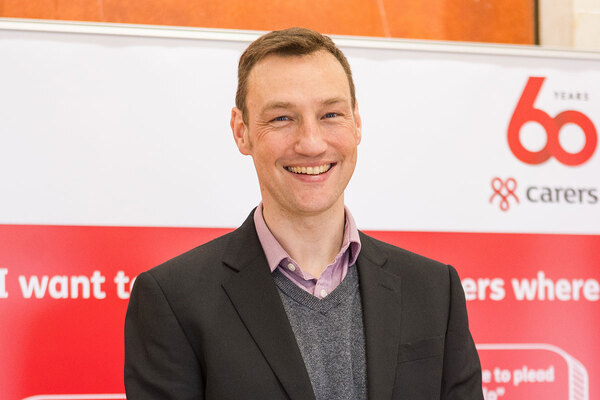
Alex Smith is Housing First lead at Homeless Link
 Unlike America, England should be more ambitious in scaling up Housing First nationally to support people experiencing homelessness, writes Alex Smith, Housing First lead at Homeless Link #UKhousing
In July, the Trump administration issued an executive order that will end bipartisan support for Housing First policies in the US amid a shift to an enforcement-heavy crackdown on homelessness and rough sleeping.
Domestically, while there have been hints of Housing First support from Labour, including manifesto rumblings in 2024, we have heard almost nothing on their plans for the model since they came to power. There is little indication of how – or even if – Housing First will feature in the upcoming Homelessness Strategy.
In 2021, the Centre for Social Justice (CSJ) published Close to Home. The report called for a national Housing First programme for England, supporting a minimum of 16,500 people experiencing the sharpest end of homelessness. The non-profit organisation, along with Homeless Link, were in the vanguard of calls for Housing First.
Although CSJ is still advocating for and shining a much-needed spotlight on the model, in No Place Like Home, its latest publication, it is now scaling back on this ambition.
So what is next for Housing First?
Housing First works. There is an overwhelming body of evidence, including the evaluation of the government’s own pilot scheme. The cost-benefit analysis alone shows that the pilots averaged expenditure of £7,700 per person per year, with long-term savings estimated at £15,880 per person per year. The Ministry of Housing, Communities and Local Government concluded that the services “delivered good value for money”.
“The cost-benefit analysis alone shows that the pilots averaged expenditure of £7,700 per person per year, with long-term savings estimated at £15,880 per person per year”
Beyond cost savings, Housing First is actively ending homelessness, with 84% tenancy sustainment rates.
Homeless Link’s More Than a Roof research also showed that, after three years, people were more engaged with planned health care, and experienced improvement in physical and mental health and reduced drug and alcohol use. There were also huge reductions in anti-social behaviour and contact with the criminal justice system.
Nicholas Pleace, professor of housing and society at the University of York, concluded in a recent podcast that the approach was “frustratingly do-able”, and yet we were still grappling with marginal gains: CSJ scaled back its ambitions from a national programme to a much more modest 5,571 places by 2029-30.
In addition, the CSJ report’s messages on migration are extremely concerning, with calls for eligibility tests for Housing First. However, the intervention is already over-represented among a white British demographic. Rather than further restricting access to an effective housing and support model, access should be expanded, to ensure that our system works for everyone.
Furthermore, the suggested requirement for people to have a local connection is unhelpful. Local-connection rules for veterans, domestic abuse survivors and care leavers experiencing homelessness have recently been eased. Importantly, Housing First’s success relies on maximising flexibility, choice and control for residents.
Since 2022, amid much advocacy from a diverse range of people, the sector has held its collective breath for long-term, strategic investment in efforts to end homelessness. With the Rough Sleeper Initiative and extension of the pilot areas from 2022-25, there was an element of stability.
However, unlike our neighbours in Scotland and Ireland, we continue to lack a national programme and strategy for Housing First expansion. Now, we see signs of the system cracking under the weight of this lack of leadership and investment.
Homeless Link’s latest review of homelessness services found that Housing First was the only reported initiative to experience a decline when compared with previous years. With large areas, such as Birmingham, now unable to continue to deliver the model because of funding constraints, never mind making marginal gains, we may find Housing First progress rolled back altogether.
“With an ever-growing number of people being pushed into rough sleeping and trapped in temporary and other short-term accommodation, now is the time to invest in what we know works”
We don’t have to look too far to see the success Housing First can bring. Finland, a country not entirely dissimilar to England, has almost ended homelessness with its approach. For decades, Finland has embraced the philosophy that a permanent home is a human right that extends to everyone.
In England, and elsewhere, Housing First has developed in parallel to, rather than being integrated into, the homelessness system. We have scaled up on the premise that it is an expensive model for a specific and limited number of people and must therefore be kept distinct and small. But what if we took Finland’s approach: a move away from a system of temporary housing, and a philosophy of housing first?
A minimum of 16,450 people require a Housing First approach. Beyond that, we know that a permanent home, with appropriate support, is the only true end to someone’s homelessness. With an ever-growing number of people being pushed into rough sleeping and trapped in temporary and other short-term accommodation, now is the time to invest in what we know works.
It follows that we need a greater ambition for Housing First, not a scaling back.
Alex Smith, Housing First lead, Homeless Link
Sign up for our homelessness bulletin

Already have an account? Click here to manage your newsletters
Related stories