In the hot seat
Who better to interview Chartered Institute of Housing president Howard Farrand than a couple of up and coming CIH members? Lydia Stockdale eavesdropped on their line of questioning.


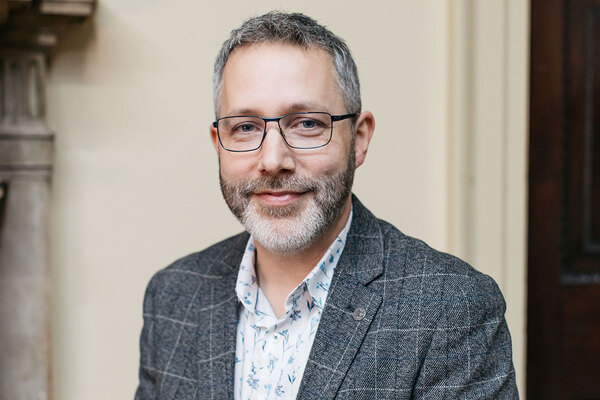
Howard Farrand is jet-lagged. But, although six-weeks touring the Far East and Australasia on Chartered Institute of Housing business have taken their toll on its president, Mr Farrand is not about to be afforded leniency.
He has some visitors: two CIH student members are about to give their president a thorough grilling. John Clark, 27, and Chris Shepherd, 31, are at the Coventry offices of Whitefriars Housing Group, which is part of West Mercia Housing Group - where Mr Farrand is group chief executive - to ask him the questions they believe all paid-up CIH members want answers to. And with 2010 set to be a pretty challenging year for the sector, this year’s face of housing has some pretty lively answers.
John Clark What are the CIH’s priorities for the year ahead?
Howard Farrand All healthy organisations get to the stage where they need to press the refresh button and ask whether they are in the best shape. That’s one of the things CIH has been asking itself: is it doing business in the best way to serve its client base, and to meet all of the political and environmental pressures that exist at the moment?
We’re facing a time of unparalleled change. We’re going through political change, the way we’re being regulated is likely to change, and the expectations of our customer base are changing. I’ve worked in and around housing for 37 years and I’ve never seen a change agenda like it.
We’re conducting a membership review and a governance review. CIH members right across the housing front look to us to be in a position to understand the implications of that change, and put policy change into best practice.
Chris Shepherd How well-placed is the CIH to influence government?
HF I think it is placed very powerfully because it represents the whole sector. The CIH is not seen as a trade body with an interest to serve. The strength of the CIH is that it is independent and that has to have a resonance with government and the regulator [the Tenant Services Authority].
JC How will the CIH react to the personalisation agenda?
HF We recognise that if we are going to support people in their own home, a one-size-fits-all approach isn’t going to work. The trick is extending this across a whole range of services. I don’t really know [how you do that] at this point in time. I don’t think anybody really knows.
It’s pretty clear that personalisation is going to be the future agenda, and I think we’re going to need to find models by which to deliver it. At the moment, the [CIH’s consultancy arm] is working on commercial models like the ‘Tesco model’, which identifies six types of customer. This will have its place, but it’s not the only answer by any means.
CS Housing covers support, estate management, income collection, and so on. Could housing roles become more specialised?
HF My own preference would be that we keep a generic housing person. I favour the model where there is one person who is your immediate contact who connects you to everything else. A model which allows residents to say: ‘It’s a housing officer I know, I have some sort of trust and a relationship with.’
CS Is it time to address the issue of life-long secure tenancy?
HF You swine - that’s a good question… My personal view is, we ought to very seriously be looking at properties with tenants in them; the rent that they pay really ought to bear some relationship to their ability to pay…
So there is a capped rent for people on a low income. That person does well, moves up, but they don’t want to move area, they’re in a nice unit. Should they be in that unit at the same rent level as someone who is really hard up? I don’t think that’s right. If someone is moving up, [with more] ability to pay - we should be looking at having more flexibility, a new rental model. There’s probably going to be hell to pay me saying that, but there is a real issue.
JC Are social landlords best placed to tackle worklessness?
HF Whether we like it or not, we are agents of social policy. Whether we actively engage in a process of social policy, or whether you just say, it’s not my issue, and just carry on with what you’re doing, one way or another you are influencing social policy. There is no opt out… \
We should be saying that we are party with other agencies to having an input into that social policy to try to get people back to work. We shouldn’t be doing it at the expense of our existing tenants, but we will have lots of opportunities if we think about how we can work with other colleagues to get people on a firm footing. Using schemes, projects, spend to get people back to work.
JC Where does the CIH stand on localism?
HF The CIH position on localism is: anything that gets us closer to the customer is good. We need to be about delivering a better service. In policy terms we are very aware that all three [main polictical] parties are pushing ahead with a localism agenda.
CS In these difficult economic times, why should organisations and individuals spend money [from £49 up to £272 a year] on CIH membership?
HF Ohh. It’s like any sales deal. You need to be satisfied before you spend your money that you are going to get value for money.
You can operate in the housing field without CIH membership, but I don’t think you can be the best you can be without drawing down on a source of expertise.
JC I’m funding my studies with the CIH myself. It’s a struggle to save up the £2,000 annual fee because you can’t pay monthly.
HF It’s that sort of input we need to listen to. I can’t comment on that in terms of policy, but we do need to look at that and see that it is a blockage to people.
JC The CIH lost £1.4 million between December 2007 and Decmber 2008, mainly down to stock market losses. How is it moving on from this?
HF Things took a tumble, everything took a tumble. We’re not isolated from an economic climate. We sit with stock investments that we have sat with for a period of time. We have not changed our investment broker, but we [have] moved to a defence portfolio, which means we shifted stuff to where the safest ground is going to be.
As we’ve seen early stages of recovery, we’ve moved that to a slightly less defensive portfolio that is more into some of the equities which have moved more quickly…
You have to take the best advice you can and hold your nerve.
CS Why have you chosen to support Homeless International through your President’s Appeal?
HF The dilemma was, do I choose a worldwide charity, or at a time of real difficulty, do I choose a United Kingdom-based charity?
I just thought that Homeless International was doing things that are saving lives. It didn’t parachute in and tell people what they should be doing; it worked with local people, teaching and empowering them. And when they were on their feet, it came out. I thought it was a more sustainable way of doing things…
Our apprentices here [at Whitefriars], picked it up as a project. Build a portable slum dwelling. I challenged them to spend the night in it to raise money for the charity.
CS Did you stay overnight?
HF They did return the challenge - and I asked them for a bit of latitude. I’ll do it - but at 62, I’m not going to do it until it warms up at bit.
Meet the inquisitors
John Clark, 27, is a contract services manager for housing association Places for People and has worked in social housing for three and a half years. He has a law degree and masters in EU studies and politics, and is part way through a three-year MSc is housing studies with the CIH.
Chris Shepherd, 31, is also completing the CIH’s MSc in housing studies. He has spent a decade in social housing and is a business improvement manager at The Wrekin Housing Trust, a housing association in Shropshire. Mr Shepherd has already gained a distinction in the CIH’s National Certificate in Housing (Tenant Participation pathway).
The president’s men? How the questioners thought it went
John Clark Howard was approachable and able to get answers across in a way that is understandable and open to further questioning. He did not step back from the difficult topics.
Chris Shepherd It was a refreshing idea to allow challenging questions to be put directly to the president, and it was really positive to hear Howard being so honest and frank with his answers. Hopefully the whole concept is just the beginning of bringing the views and opinions from the frontline directly to the CIH.

Related stories