You are viewing 1 of your 1 free articles
No more dark corners: the regeneration team focusing on outdoor space
An estate regeneration project in west London highlights a new approach to resident engagement in placemaking. Kate Callaghan visits to find out more


 No more dark corners: the regeneration team focusing on outdoor space #UKhousingAn estate regeneration project in west London highlights a new approach to resident engagement in placemaking. Kate Callaghan visits to find out more #UKhousing
No recent housing sector event has been complete without debates and new commitments on place and regeneration. This is why Inside Housing is partnering with the Northern Housing Consortium and PlaceShapers on a new series, called Spotlight on Regeneration, focused on the delivery of housing-led regeneration schemes across the UK.
With that in mind, Inside Housing visited developer Mount Anvil and housing association Peabody’s regeneration of the Friary Park Estate in Acton, west London.
The partners have taken a tenure-blind and resident-first design approach that extends beyond just buildings. This method involves putting residents’ voices at the centre of the design and encouraging a sense of community between old and new tenants, particularly through the outdoor spaces and play areas.
But how can these schemes ensure they have residents at their heart, and how does tenure-blind design help build integrated and engaged communities?
Regenerating Friary Park Estate
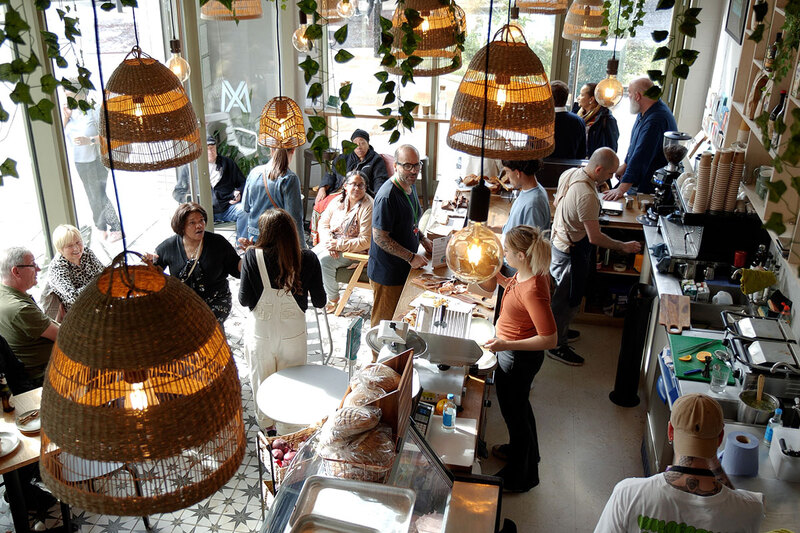
I meet the team behind the regeneration of the Friary Park Estate in By Max, a lively modern coffee shop just outside Acton Main Line Station. They tell me proudly that owner Max is a local resident who was given a grant to set up his coffee shop in the base of the one of the new blocks of flats on the estate.
Peabody started regenerating the estate in 2014, with Mount Anvil joining the project in 2019.
When Inside Housing visits the site in September, the first phase of the project has been completed, during which 135 affordable homes were built. Of these homes, 85 were provided to residents from the original estate and 50 were allocated to households on Ealing Council’s housing waiting list. The third phase of the regeneration was granted planning permission in April this year.
The original estate was a network of cul-de-sacs of low-rise flats and terraced homes. It was built in the late 1980s for private sale, but was purchased by Ealing Family Housing Association (now Peabody) in 1988 to provide social housing. Around a third of the original estate remains today, alongside the newly finished homes and the construction sites for stages two and three of the regeneration. The finished development will provide a total of 1,345 homes, 470 of which will be affordable.
I’m led from Max’s coffee shop, past an Asda, along the promenade connecting the flats and through to the shared garden, where I sit down with the team in the site office to discuss the partners’ approach to this redevelopment.
“What’s been really important for us is not just the inside of Friary, but how what we’re doing will have that ripple effect beyond our homes and to the wider area,” says Serena Horgan, head of development delivery at Peabody.
The route the team took me through is a key part of their design process. “[It] maps a journey of a resident that lives at Friary. They come out of the Elizabeth Line Station, stop by By Max, and walk through the green space to an event happening in the new community facility,” Ms Horgan explains.
“So, for us, it’s being able to visualise more than just the existing place, and that’s exactly what real regen should be. It should be spilling beyond your plot of land.”
The team thought carefully about the choice of businesses in the ground-floor space – they chose Asda based on what would be suitable for Peabody’s affordable housing residents and rejected applications from chain cafes in favour of the resident-run coffee shop.
“Doing that project with By Max, and how he’s used that outdoor space, is significant,” Ms Horgan says. “[The shop is] quite lively and buzzy, so it makes a real change to that corner.”
Resident engagement
All this is part of Peabody and Mount Anvil’s “listening-first” approach. Since the project’s inception, there has been a resident steering group for original residents of the estate to voice opinions and feedback on designs. For instance, testing ideas for the parking strategy and options for the kitchens in their flats.
The resident group can also provide feedback during monthly meetings and the more than 400 community events organised by the team.
“The residents, they are ultimately number one – they’re who we’re delivering for,” says Kieran Jones, senior site manager for Friary Park at Mount Anvil. “I’ve been here for nearly three years. We know the residents; they know us. They can speak to us. They can call us.”
Mount Anvil and Peabody also established an independent advisory board. This is a group of industry experts, separate to Mount Anvil and Peabody, who hold meetings with residents.
“It’s a case of residents being in a safe space,” Ms Horgan explains. “They might not necessarily want to always say to myself or [the site manager or construction director that] they ‘weren’t happy with X, so we think you could do this better’. Whereas in that environment, speaking in those [independent advisory board] meetings, I think is a good opportunity to then voice concerns externally, that are then fed back to us in a private format.”
Tenure-blind design
Another aspect of the partners’ approach is ‘tenure-blind’ design. All the buildings have been designed in the same style, so externally the affordable housing is indistinguishable from the private market homes.
Ms Horgan is keen for private residents to also join the steering group. “Sometimes you can be focused on your existing community, which is obviously paramount for us, but we want to have that natural overlap with the new residents that come through,” she says. “We want [the steering group] to be representative of what Friary will be like in the end, because it will be a very mixed-tenure community.”
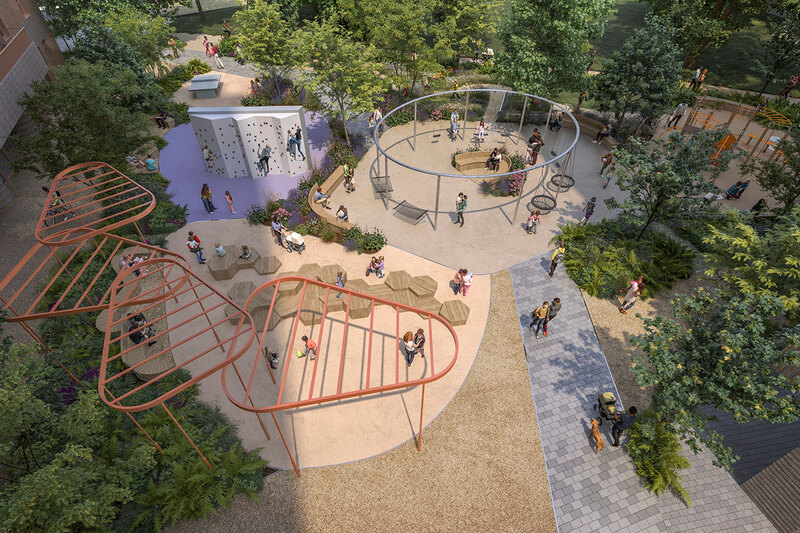
This tenure-blind approach extends to the outdoor spaces. There are shared roof terraces, gardens and multi-use sports pitches, which can be accessed by both private and affordable housing tenants. There are some facilities within the homes for private market tenants, such as a gym and concierge, but affordable housing residents can choose to opt in for these facilities.
“That’s a basic design principle of ours. We don’t discriminate. We don’t put up any artificial or physical barriers as to who can access it,” says Tom Beardmore, social value and communications director at Mount Anvil.
It is a topic that has sparked controversy in recent years, with examples hitting the press of developments where children from affordable homes in a development were not allowed to use the play area designated for private residents.
A survey carried out by charity Save the Children found that only 27% of children play regularly outside their homes, compared with 71% in their grandparents’ generation. Research from the Association of Play Industries in 2022 revealed that children in London have access to almost five times fewer public playgrounds than children in Scotland.
At Friary Park, young people from the estate were involved to share ideas about the design of the new play space, and Mount Anvil has partnered with the charity Make Space for Girls. It also worked with consultant Light Follows Behaviour on lighting outdoor spaces in an inviting way and removed dark corners that might make people feel unsafe and encourage anti-social behaviour.
Mount Anvil is not just doing this at Friary Park but on other projects, too. The developer is collaborating with the London Lions basketball team to construct communal basketball courts on a number of estate regeneration schemes.
On the Barnsbury Estate in Islington, where the regeneration has recently been granted planning permission, children who currently live on the estate helped design the basketball court. Mr Beardmore reflects on the session: “We had a couple of the Lions coaches and they were shouting out things like, ‘If you’d like your basketball court to be full of jungle themes, run to that post [on] the far right.’ And we had 20 to 25 under-10s running all around this court.”
This exercise encouraged the parents of the children to become more involved in the regeneration process. “They were curious about what was going on and before you know it, they were part of our community engagement. That was just a brilliant example of working with people, like the Lions, just to reach further into this estate than what we would do normally,” Mr Beardmore adds.
At another regeneration development on the Isle of Dogs, Mount Anvil’s community engagement manager identified a group of girls using the local community sports centre to play basketball. However, due to a lack of funding, the community centre was due to close. Over the next couple of years, Mount Anvil was able to provide funding to keep the space open and brought in coaches and equipment. The team is now an official club called the Cubitt Town Girls Group and Mount Anvil plans to put a plaque for them on the sports pitch once the regeneration is finished.
“Basketball was the medium and London Lions were the partner, with the expertise to get the girls engaged at the start,” Mr Beardmore says. “It’s character-building. It’s the cohesion and the confidence that, I think, the girls probably say they’ve most benefited from.”
This is a project that has been praised by the London mayor, who has separately set up a basketball taskforce to expand the sport’s reach and engage young people. A spokesperson for the mayor says of Mount Anvil’s scheme: “It’s brilliant to see initiatives like this provide positive spaces for young people to come together and play sport… This is how we continue to build a better, greener and fairer London for everyone.”
Reflecting with a view
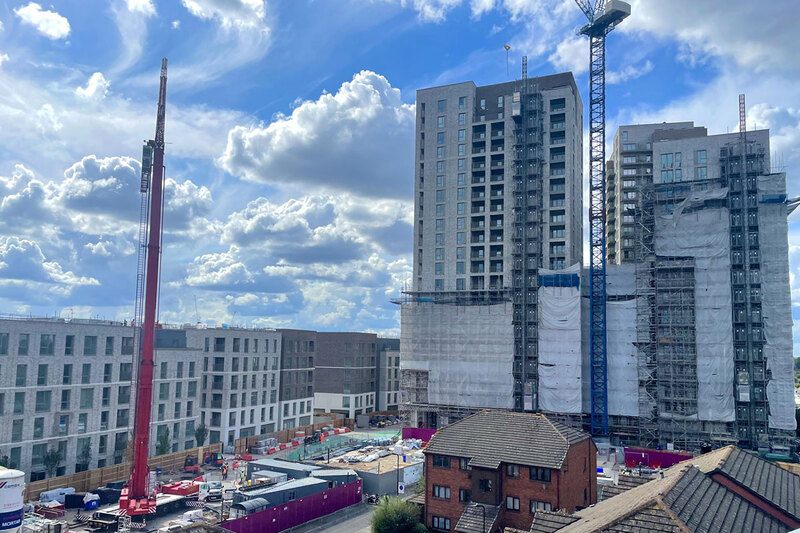
We finish the tour of Friary Park on a roof terrace overlooking the site: the old estate, completed Phase One and ongoing building works. The regeneration team points out aspects from the old estate that residents wanted to improve, such as the size of balconies, dark areas behind bin sheds and places for more outdoor space.
“The phased development gives opportunity for learning and taking on feedback,” says Mount Anvil’s Mr Jones. “The feedback from residents was the windows on Phase 1A were not necessarily the most user-friendly, so we went out to the market, looked at what we could do on following phases, what we could change, what feedback we could take on board.”
During a planning committee meeting for Phase Three, it became apparent the residents do feel listened to. Sofia, a Friary Park resident of 19 years, spoke in support of the application.
“I’ve worked alongside Mount Anvil and Peabody. I’ve attended meetings, spoken up and raised concerns not just for myself but on behalf of my neighbours, and I’ve seen a real willingness to listen,” she said at the planning meeting. “Mount Anvil and Peabody have taken time to understand us. They responded to our feedback and collaborated with us.”
Longform reads from our regeneration and placemaking special week of content
The regeneration scheme that changed more than the housing
As a child, Barratt London’s Syreeta Robinson-Gayle lived on an estate that was redeveloped. Peabody’s Ian McDermott worked on the plans. Martin Hilditch reunites them to find out how the experience still affects their thinking, kicking off our week-long focus on regeneration
How to restart regeneration
What is stopping regeneration projects from getting off the ground? Hannah Fearn finds out. This story is part of Inside Housing’s new series called Spotlight on Regeneration
It was a coal mine, then the site of a clash between miners and police. We visit Orgreave to see how it has been transformed
Waverley, a new town in South Yorkshire, is built on the site of Orgreave Colliery, where miners and police clashed in the 1980s. Jenny Messenger visits the scheme to find out more
Board Member Briefing: the board’s role in a successful regeneration
Regeneration projects can take decades and the scope of work may shift over time. How can board members of housing associations keep a handle on these projects that will probably outlast their tenure and many of the executive team? Hannah Fearn reports
CPD module: how to carry out a meaningful tenant consultation for estate regeneration
Successful estate regeneration requires open dialogue with residents who are affected. Emma Gilpin, head of consultancy at tenant advisory service Tpas, and David Smethurst, associate at Tpas, explain how to go about it
No more dark corners: the regeneration team focusing on outdoor space
An estate regeneration project in west London highlights a new approach to resident engagement in placemaking. Kate Callaghan visits to find out more
Sign up for our development and finance newsletter

Already have an account? Click here to manage your newsletters
Sign up to HOMES UK and Unlock Net Zero Live 2025

Whether your focus is building safety, sustainability, development, AI and digital transformation, housing management, procurement, or resident engagement, this is a must-attend event for all UK housing professionals.
Explore opportunities to increase affordable housing supply and improve the quality and sustainability of existing homes.
Related stories