Stuck in the middle
More than 2.5 million people in the UK are ineligible for social housing but cannot afford a home on the open market. Keith Cooper looks behind the glossy brochures at the multi-billion pound intermediate housing market


You either are one, know one or are glad you aren’t one. The housing inbetweener: earns too much to qualify for state housing but too little to buy their first home. Actually, you probably know lots of them - the latest figures suggest that more than 2.5 million people in the UK face this predicament.
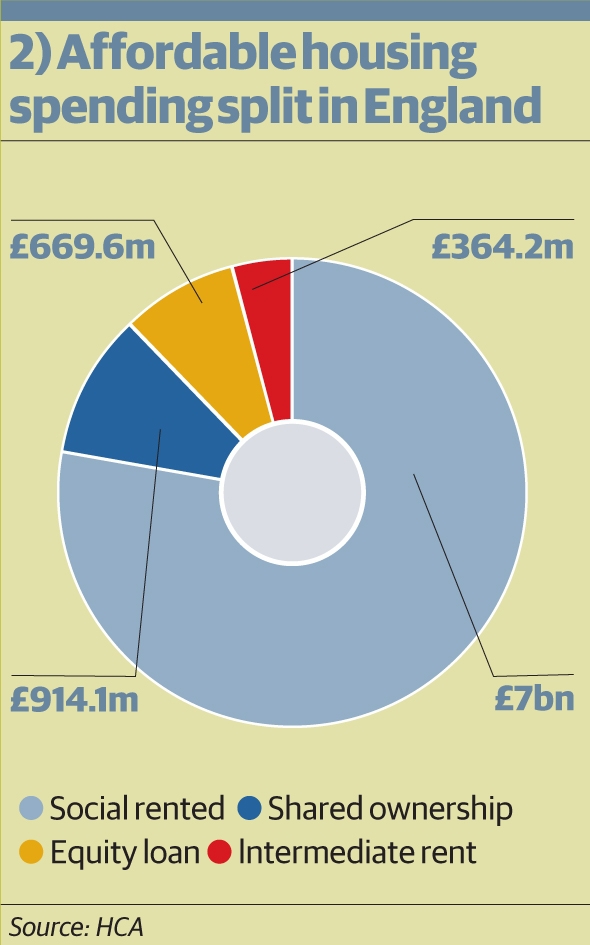
Recognition of what has come to be known as the intermediate housing market has grown steadily during the past two decades. More than a fifth - £1.9 billion- of the government’s affordable housing budget for 2008 to 2011 is earmarked for intermediate homes. And the range of available products has expanded beyond the shared ownership first offered in 1979, to include shared equity and, most recently, rent to buy homes as well.
But opinion is split over what kind of housing works best for the inbetweeners.
Lenders’ groups tend to favour equity loan schemes, while many housing associations say shared ownership schemes offer a better deal. Others, like 62,500-home association Places for People which offers 14 different routes into homeownership, are hedging their bets with a range of products. Meanwhile, the English and Scottish governments have launched full-scale reviews of their low-cost homeownership programmes.
Change of the tide
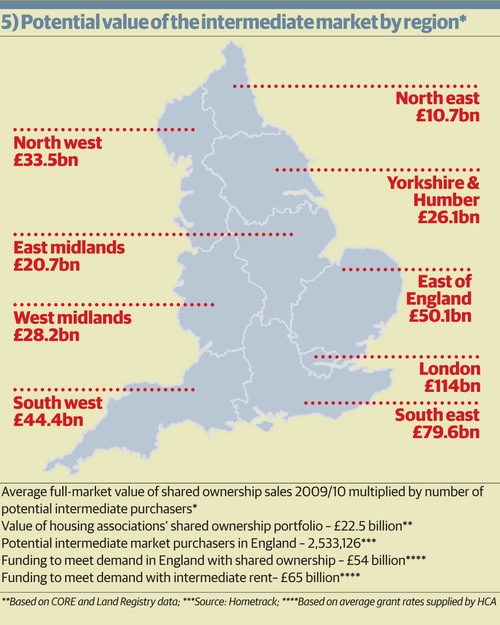
With 2.5 million inbetweeners comprising a market worth, Inside Housing can reveal, more than £400 billion in England alone intermediate housing has become impossible to ignore. So what kind of state is it in, and where does its future lie?
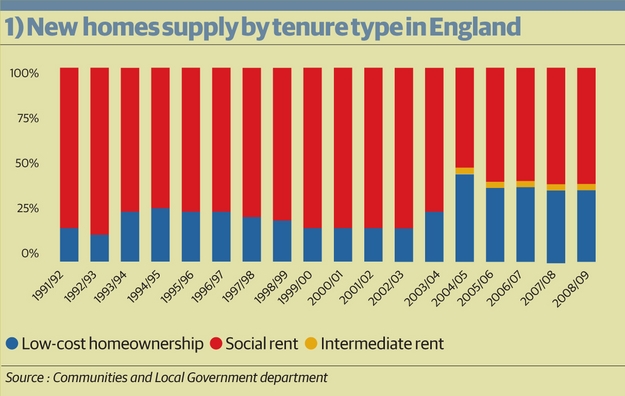
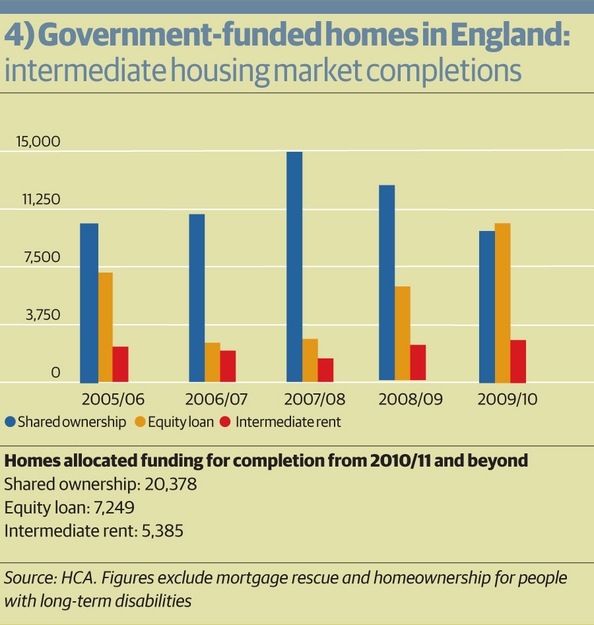
Pre-credit crunch, shared ownership schemes, where purchasers buy part of their home and rent the remaining share from a housing association, were the most popular intermediate products (see graph 4). But the 2007 liquidity crisis prompted a significant change in the market as risk-averse lenders shied away from shared ownership mortgages in favour of equity products. These reduce lenders’ risk by requiring the purchaser to buy a much larger stake in their home.
‘If it is a question between equity loan and shared ownership then lenders have a preference for equity loan schemes. It is more closely allied to the mortgage model,’ a spokesperson for the Council of Mortgage Lenders says. Shared ownership is likely to be pushed to the periphery of the lending market, he predicts.
Several housing associations, which use shared ownership proceeds to finance new homes for social rent, have formed a lobby group called the Promoting Shared Ownership Group. Yvette Ruggins, chair of the National Housing Federation’s homeownership advisory panel and sales director at 54,500-home Affinity Sutton, says there are significant efforts underway to quash the perception that shared owners are risky. ‘While there is no doubt that the number of lenders and products available have declined over this period, this is the case for the whole market,’ she argues.
Despite such efforts, there’s growing consensus that a shift away from shared ownership is a good thing. Many housing associations say the model is ‘broken’ since it no longer generates the cross-subsidy required to build social homes.
Steve Wilcox, a housing professor at the University of York, says that the market must be re-examined. ‘Shared ownership was devised as a policy response to the more classic problem of affordability,’ he says. ‘With today’s very low interest rates, it is more about [first time buyers’] access to mortgages and securing a deposit rather than pure affordability. In that context, you have to rethink the intermediate market.’
Richard Donnell, director of research at consultancy Hometrack, points out that developers have also begun to favour equity share products, and not just because the recession dampened people’s demand for buying a home outright. ‘Homebuy direct [the government’s equity loan product] has given them an appetite for this and the large players all have their own schemes,’ he says.
Wave of the future
Indeed equity schemes are already gaining ground on their older counterparts. Last year, the number of homes completed under the government’s equity loan programme for the first time outstripped shared ownership completions by 13 per cent, according to figures from the Homes and Communities Agency.
The popularity of a similar scheme north of the border has also soared. The number of equity loan homes completed in Scotland shot up from 195 in 2005/06 to 2,180 last year, largely due to its open market equity loan pilot programme.
The success of equity loan schemes is largely due to the large sums Westminster and Holyrood poured into them to keep developers afloat as the mortgage market collapsed around them. The English government spent £670 million on equity loan schemes between 2008/11; its Scottish counterpart spent £124 million between 2005/06 and 2009/10.
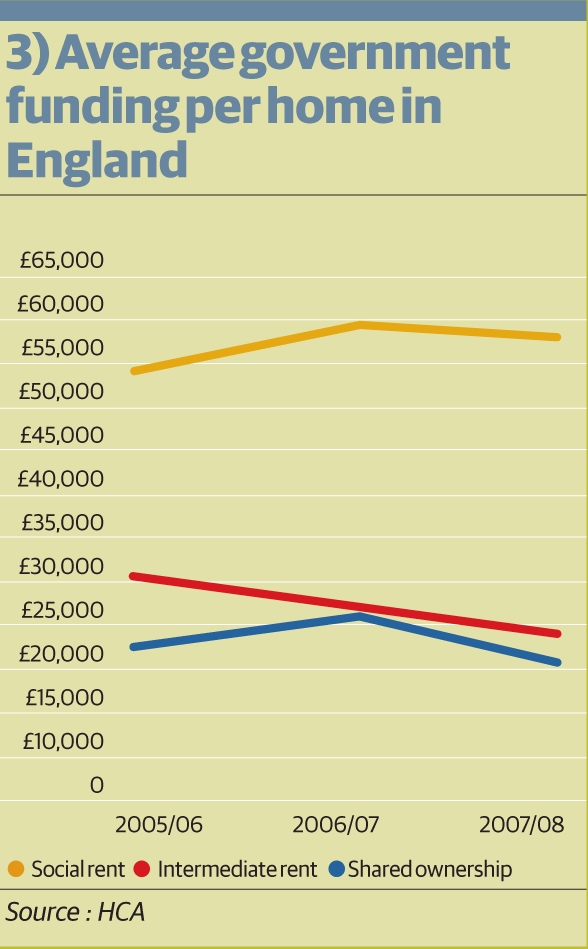
What does the taxpayer get for their trouble? At first glance the government’s equity push doesn’t seem to offer brilliant value. The state pays more for an equity scheme than a shared ownership one.
Jamie Ratcliff, head of intermediate markets at the HCA, says equity products are only more expensive because they are generally used to help people buy existing homes priced at market value. Shared ownership costs, on the other hand, can be squeezed because developing associations bid for funding in a competitive tendering process. HCA figures show this has pushed down the average cost per home from £24,817 in 2005/06 to £21,399 while the cost of delivering a socially rented home remained relatively flat.
Long-term benefits
Glen Bramley, a professor in the school of the built environment at Heriot-Watt University, suggests that overall low-cost homeownership products represent money well-spent for its backers: ‘In the long run a lot of people staircase up and the government gets its money back.’ He adds that taking the long view flatters shared ownership in particular.
‘When we evaluated shared ownership in 2002 our study suggested it was self-financing in the long run. I don’t think it is entirely, but it gets close to it,’ he says. Whether this will be enough to persuade the chancellor to stump up the £54 billion needed to meet unmet intermediary demand in next month’s comprehensive spending review remains to be seen.
Yet Professor Bramley’s research calls into question the shared ownership model’s value to the consumer. ‘The housing association sector, with a few honourable exceptions, is using low-cost homeownership to make a profit to cross-subsidise. In the end, they make more surplus and their shared ownership rents are higher than they need to be.’
Certainly inbetweeners, it seems, are better off on average as equity, rather than shared owners once deposits and service charges are factored in.
Professor Bramley says the latest generation of intermediate products - ‘try before you buy’ offers such as rent to homebuy in England and mid-market rent in Scotland - are obvious solutions to help people save for deposits. To date, schemes have not proved as popular as equity share and have been slow to get off the ground in Scotland. Just 18 such homes were funded north of the border in 2009/10 compared with 1,933 over the same period in England.
The UK government is expected to reveal its plans for the future of state-backed homeownership schemes in next month’s spending review. Many are optimistic that housing minister Grant Shapps’ enthusiasm for ‘an age of homeownership aspiration’ will translate into some financial help for the inbetweeners, if only a fraction of the £54 billion needed to meet demand. Either way, with unprecedented demand for its products, there’s little chance the intermediate market will stand still.
Shared ownership properties provided in Northern Ireland
| YEAR | HOMES |
|---|---|
| 2000/01 | 510 |
| 2001/02 | 645 |
| 2002/03 | 801 |
| 2003/04 | 463 |
| 2004/05 | 502 |
| 2005/06 | 504 |
| 2006/07 | 325 |
| 2007/08 | 935 |
| 2008/09 | 325 |
| 2009/10 | 461 |
Welsh homebuy scheme
| YEAR | HOMES | SPEND |
|---|---|---|
| 1999/00 | 21 | £0.3m |
| 2000/01 | 91 | £1.4m |
| 2001/02 | 188 | £3.8m |
| 2002/03 | 265 | £6.3m |
| 2003/04 | 196 | £5.7m |
| 2004/05 | 202 | £7.4m |
| 2005/06 | 202 | £10.1m |
| 2006/07 (programme suspended in 2007.08) | 222 | £10m |
Affordability of equity share based on a £160,000 two-bedroom flat
| HOMEBUY DIRECT | |
|---|---|
| Equity share purchased | £112,000 (70%) |
| Deposit of 5% | £5,600 |
| Total mortgage | £106,400 |
| Monthly payments | £622 for first five years |
| Affordable for salary of | £21,000 |
| Loan charge for sixth year | £74 |
| Total for sixth year | £696 |
Relative affordability of shared ownership based on a £170,000 two-bedroom flat
| SHARED OWNERSHIP | MARKET SALE | PRIVATE RENT | INTERMEDIATE RENT (20% off) | |
|---|---|---|---|---|
| Monthly mortgage payment | £370 | £854 | N/A | N/A |
| On a | 40% stake (£68,000) | £170,000 mortgage at 5% rate | N/A | N/A |
| Deposit required | £10,200 for a £57,800 mortgage at 5.79% | £25,500 | N/A | N/A |
| Rent charge | £212 based on 2.5% on unsold equity | N/A | N/A | N/A |
| Total monthly payment | £582 | £854 | £824 | £660 |
| Affordable for salary of | £20,000 | £30,000 | £28,000 | £23,000 |


Related stories