A slice of life
1 April was a watershed moment for social landlords and their tenants as the government’s controversial welfare reforms kicked in. Over the next year, Inside Housing will track the impact on their businesses and lives through our new welfare reform focus group. Lydia Stockdale reports



The day that so many people were dreading - Monday 1 April 2013 - has been and gone, and the ‘bedroom tax’ is now in force. More than 600,000 tenants across the UK are subject to the under-occupation penalty, meaning they now have to stump up an average of £14 per week to pay for their spare bedrooms.
Throughout the year, further changes to the benefit system will lead to the biggest shake-up of welfare in decades.
How this will affect tenants and their landlords is currently the subject of much speculation, but the reality is that nobody knows exactly what will happen.
Monitoring change
We asked 10 social landlords of different shapes and sizes, working in very different locations across the UK from Cornwall to Falkirk, to join our welfare reform focus group and help us track the impact of welfare reform as its various different elements hit.
They’ve agreed to regularly update us on the facts, figures and financial information that will help us monitor the effect in real time. They’re also providing us with details of individual households who are affected by welfare reform.
Over the coming 12 months we will publish these families’ stories as they play out. At the moment they’re finding it difficult to comprehend that they may have no choice but to move out of their homes.
An exclusive survey of 73 social landlords by Inside Housing, published last week, showed nearly half of tenants affected by the bedroom tax plan to pay the penalty in order to stay in their homes, although many social landlords wonder how they’re going to find the money.
When the government first announced its welfare reform plans in 2010, Inside Housing launched its What’s the Benefit? campaign. It won the backing of nearly 2,000 people who signed our online petition which said: ‘We are concerned about the impact that the proposed changes to housing benefit and local housing allowance would have on communities across the UK.’
Despite strong opposition as the proposals made their way through parliament, with MPs and peers clashing on key issues, the Welfare Reform Act received royal assent in March last year.
Now Inside Housing plans to highlight the act’s impact and the 10 members of our welfare reform focus group have agreed to provide us with information every three months to help us to do so. They will tell us the level of arrears among their tenants, the turnover of properties, their average void periods, housing waiting list numbers, the number of tenants who have downsized, the number of tenants on full and partial housing benefit, the number of tenants affected by the bedroom tax and the percentage of those tenants who are in arrears.
On top of this, we’ve asked to be informed of any staffing changes, which will highlight how organisations are reshaping their teams to deal with the fallout from the reforms.
Key information
We’ve picked out some key pieces of initial information and printed them here to give an idea of what life is like for landlords and their tenants now, before the reforms start to bite.
Our aim is not to compare the facts and figures provided by the 10 organisations in our welfare reform focus group - the information they’ve provided is often collected using different methods and is therefore not comparable. Instead, we’ll be focusing on the circumstances of each individual organisation.
Although our first set of figures is effectively our ‘control’ information, against which all subsequent information will be measured - there are already some statistics that jump out. For example, a large proportion of tenants who are being hit by the bedroom tax are already in arrears.
In Salford, 44 per cent of arm’s-length management organisation Salix Homes’ tenants who are of working age and are under-occupying their properties are already in arrears. The level of arrears among tenants in this group is disproportionately high - 28 per cent of all Salix’s tenants are behind on their rent.
‘It is difficult to pinpoint any one reason why arrears [among tenants that are being hit by the bedroom tax] would be at this level,’ says Sue Sutton, the ALMO’s director of customer and neighbourhood services.
‘It could be due to a number of reasons, such as people who are in and out of work, whose change of circumstances would have an effect on their benefits,’ she suggests.
‘Tenants in social housing are vulnerable to changes in their circumstances, such as changes to benefits, which means they are more likely to fall into arrears. The definition of arrears is quite broad. Tenants can temporarily fall into arrears one month and be out of arrears the next,’ she explains.
Problems scheduling direct debits or delays in the processing of housing benefit payments can lead to tenants falling behind on their rent.
‘It should also be remembered that in the majority of cases of tenants in arrears, the actual amount owed is at a very low level,’ Ms Sutton points out.
She adds that Salix Homes is concerned that, as we track the level of arrears among under-occupying tenants, the amount that tenants owe will rise as the impact of welfare reform is felt.
At Vela Group in the north east of England, nearly half of Stockton-based Tristar Homes’ under-occupying tenants, who are of working age, are already behind on payments.
The reason arrears appear high is largely because all of the housing association’s tenants have to pay water and sewage costs to their landlord, explains Kay Glew, head of housing services at Tristar.
Arrears tend to be low, and often reflect the fact that payment dates do not align with the organisation receiving tenants’ housing benefit, she says.
Tracking trends
However, there are trends that are worth keeping an eye on, says Ms Glew. Single people and those on partial housing benefit make up a large proportion of the tenants who are currently behind on payments.
Of the 1,954 Tristar tenants who are subject to the bedroom tax, 913 are in arrears - 334 of these are single people, 261 are on partial housing benefit, and 104 are under the age of 25.
As we check with our welfare reform focus group members every three months, we’ll be looking for patterns as they emerge. But no two individual stories will be the same.
Liverpool-based Riverside, for example, put forward two of its under-occupying households for us to keep in touch with - first we have Paul and Trish Holmes, aged 55 and 59, who moved to their four-bedroom house shortly after they were married 20 years ago. They’ve brought up their two daughters there, and since Ms Holmes developed severe arthritis, the property has been adapted to accommodate a modified shower, stair-lift and ramps.
They are under-occupying their home by three bedrooms, meaning they will lose 25 per cent of their housing benefit, and will have to find £80 a month in order to remain in their family home.
The couple want to downsize to a smaller property, but they will still need a two-bedroom house because Ms Holmes is so ill she has to sleep alone.
‘This is our home. We don’t want to go, but we’re being forced to,’ says Mr Holmes. ‘Even if they put us in a two-bedroom flat they would still charge us for under-occupancy. I don’t know who dreamed this tax up but it’s ruining lives.’
At the moment though, there aren’t enough two-bedroom properties to go around, with demand for such homes in the North Bransholme area of Hull, where the Holmes live, outweighing availability.
Like Ms Holmes, Maria Crossland, 60, also has disabilities. She is divorced and lives alone in a three-bedroom house which she has occupied since 1989.
She has mobility issues after recovering from a hip operation and is on incapacity benefit and disability living allowance.
She doesn’t want to move because Riverside has just renovated her house with a new kitchen and gas central heating. Her best friend lives next door and other neighbours drop in, help her with her shopping and give her lifts to hospital.
Unlike the Holmes, Ms Crossland plans to stay where she is, but will need to pay an extra £17 a week towards her rent. She suspects she will have to cut back on food and heating.
‘I’ve worked all my life and paid my way. All I want to do is stay in my own home and have my family come to see me,’ she says.
We’ll be revisiting Ms Crossland to find out whether she is managing to pay the bedroom tax in the months to come. Behind every statistic we publish, there is a life. Over the next year we’ll be revealing tough decisions that will have to be made behind closed doors in homes up and down the country.
Mark’s story
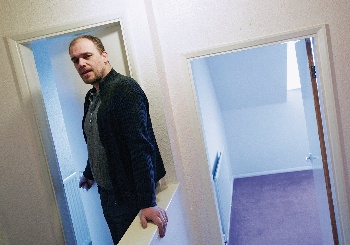
During our coverage of the impact of welfare reform, we’ll be keeping in contact with Aspire Group tenant Mark Taylor, a 45-year-old divorced father of three, who lives in a two-bedroom flat in Newcastle-under-Lyme, Staffordshire.
Mr Taylor is alone in the property most weekdays - but when his daughters, aged 14 and nine, and son, 13, come to stay with him on weekends and during school holidays, the place is packed.
All three children share one room. ‘I can see they’re uncomfortable with it,’ he says. ‘They’re polite children - they won’t moan about it - but I feel like I’m letting them down because I can’t give them space.’
The space Mr Taylor does have now comes at a price. Since the government’s under-occupation penalty came into force on Monday, £11.39 a week is being docked from his housing benefit because he is deemed to have a spare bedroom.
On top of the ‘bedroom tax’, his council tax benefit is being cut, meaning he will need to find £15 a week to cover his costs.
‘In total, that’s just over £60 a month I’ve got to find,’ he says.
Mr Taylor was forced to give up his job as a retail manager more than five years ago when sciatica and chronic back pain, caused by two prolapsed discs at the base of his spine, sometimes made it difficult and painful for him to move.
‘I need to lie down, sit and stand at various times, as my back dictates,’ he explains.
Mr Taylor is trying to find work he can do over the phone at home. He says he wants to work in order to ‘get a bit of pride back’.
Even before the bedroom tax hit, he struggled to get by.
‘I live off a loaf of bread a week for toast, so that there’s plenty of food and heat at the weekend when my children are here,’ he says.
He doesn’t know how he’s going to afford to pay the bedroom tax, but he’s determined to find a way. His immediate options are to cut back further on food for himself and to extend a high interest, short-term loan he’s close to paying off.
Mr Taylor had to obtain a court order so he could take care of his children. ‘If I’m forced to move to a one-bedroom flat, it’s more than likely their mum will turn around and say, “sorry, you can’t accommodate them, so you can’t have them”. If that happened, I dread the consequences. My kids are my life, they’re all I have,’ he says.
‘They are upset, they see what it’s doing to me,’ he adds, his voice cracking slightly. ‘I say it’ll be fine, I’ll find the money. I say it just to keep them happy. But I don’t know what to do.’
In the short term, Mr Taylor is trying to secure a discretionary housing payment from his local authority, which will see him through for three months. He’s not optimistic though. ‘I’ve read up on it and I’m just not going to get it,’ he says.
On the horizon: welfare reform in 2013
The bedroom tax
When: 1 April 2013.
What: Social housing tenants of working age will have 14 per cent of their housing benefit docked if they have one spare room. Tenants with two or more spare rooms will lose 25 per cent.
What the government says: The Department for Work and Pensions estimates 660,000 households will lose an average of £14 a week under the under-occupation penalty. The policy aims to save £500 million a year by April 2015.
Council tax benefit
When: 1 April 2013.
What: Council tax benefit was scrapped on 1 April. Instead, households can apply to their local council tax support scheme to get money off their council tax bill. The means-tested support available has been cut by £500 million and local authorities have the power to decide who is eligible.
What the government says: The localisation of council tax benefit will give councils stronger incentives to cut fraud, promote local enterprise and get people back into work.
Benefits cap
When: April 2013 in four London boroughs, across the UK by the end of September.
What: A total household benefit cap of £26,000 per year for couples and £18,200 per year for lone-parent households. Certain households, including war widows and those receiving working tax credit, are excluded.
What the government says: The benefit cap is designed to save £305 million by 2014/15, although the DWP has made £65 million available in annual discretionary housing payments.
Local housing allowance
When: April 2013.
What: Increases in LHA will be based on the consumer price index (instead of the higher retail price index) from April. Increases in LHA will then be capped at 1 per cent in 2014/15 and 2015/16. Since April 2011, LHA for new claimants has been capped at between £250 and £400 according to property size. This cap was phased in for existing claimants from 1 January 2012.
What the government says: The combined changes will save £740 million by 2014/15, according the DWP.
Universal credit
When: Phased in over a four-year period from October 2013.year period from October 2013.
What: The universal credit combines several means-tested benefits, tax credits and housing benefit into one monthly payment direct to claimants. It will be administered by a giant IT system using real-time tax information.
What the government says: The new system will cost £4 billion to implement but is expected to save £2 billion a year in administrative costs. Claimants will be expected to manage their claims online.
Leeds Council
57,576
number of properties owned and managed (as of 28 February 2013)
2.1 per cent
level of rent arrears (as of 28 February 2013)
6,794
number of tenants affected by the bedroom tax (as of November 2012)
22 per cent
proportion of tenants affected by the bedroom tax who are in arrears (at June 2012)
265
tenants downsized in 2011/12
Coastline Housing
3,933
number of properties owned and managed
1 per cent
level of rent arrears
323
number of tenants affected by the bedroom tax
26 per cent
proportion of tenants affected by the bedroom tax who are in arrears
20
number of tenants who have downsized
Riverside
36,648
number of general needs properties owned and managed
5.5 per cent
level of rent arrears
6,740
number of tenants affected by the bedroom tax
49 per cent
proportion of tenants affected by the bedroom tax who are in arrears
16,759
tenants on full housing benefit
Family Mosaic
23,000
number of properties owned and managed
4.6 per cent
level of rent arrears
1,307
number of tenants affected by the bedroom tax
44 per cent
proportion of tenants affected by the bedroom tax who are in arrears
10
number of tenants who have downsized
Hastoe Group
5,183
number of properties owned and managed
4.5 per cent
level of rent arrears (as of 28 February 2013)
143
number of tenants affected by the bedroom tax
35 per cent
proportion of tenants affected by the bedroom tax who are in arrears
16
tenants downsized since October 2012
Link Group
6,190
number of properties owned and managed
3.7 per cent
level of rent arrears
841
number of tenants affected by the bedroom tax
3
number of tenants who have downsized
4
new posts added to advice service for welfare reform activities
United Welsh
2,945
number of general needs properties
4 per cent
level of rent arrears excluding housing benefit outstanding (as of February 2013)
726
number of tenants affected by the bedroom tax (as of 26 March 2013)
12.8 per cent
proportion of tenants affected by the bedroom tax who are in arrears
9
number of tenants who have downsized
Aspire Housing
8,530
number of properties
1.6 per cent
level of rent arrears
880
number of tenants affected by the bedroom tax (as of January 2013)
28 per cent
proportion of tenants affected by the bedroom tax who are in arrears
19
tenants downsized between October and December 2012
Vela Group: Housing Hartlepool
7,006
number of properties owned and managed
£475,576
owed in rent arrears
1,153
number of tenants affected by the bedroom tax
31 per cent
proportion of tenants affected by the bedroom tax who are in arrears
57
number of tenants who have downsized
Vela Group: Tristar Homes
10,014
number of properties owned and managed
£967,351
owed in rent arrears
1,954
number of tenants affected by the bedroom tax
46 per cent
proportion of tenants affected by the bedroom tax who are in arrears
71
number of tenants who have downsized
Salix Homes
10,500
number of properties owned and managed
4.5 per cent
level of rent arrears (as of 17 March)
1,100
number of tenants affected by the bedroom tax
44 per cent
proportion of tenants affected by the bedroom tax who are in arrears
147
tenants who downsized in 2012/13

Related stories