You are viewing 1 of your 1 free articles
Andy Hulme on Hyde’s housing revolution and how it plans to play a greater role in communities across the UK
Hyde was already one of the UK’s biggest housing associations, but in the past year it has expanded massively in a bid to play an even more significant role in communities across the UK. Chief executive Andy Hulme speaks to Martin Hilditch about what the housing association’s bold new strategy means for the future


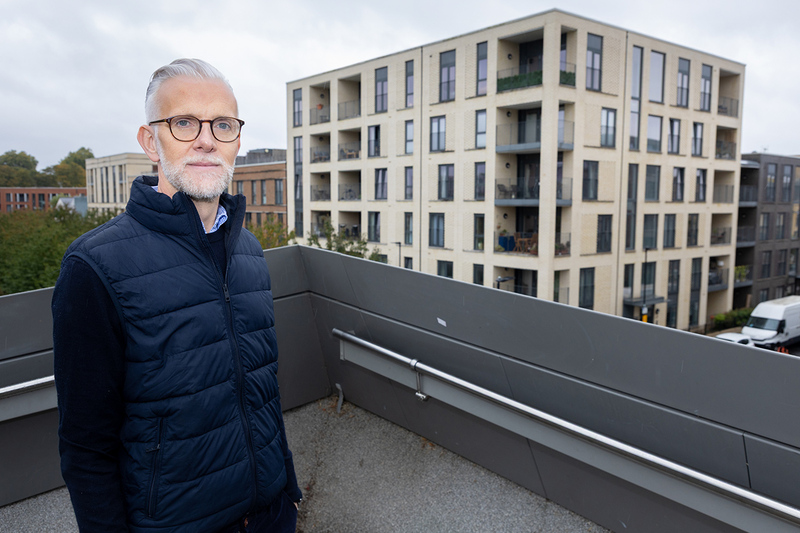 In the past year, Hyde has expanded massively in a bid to play an even more significant role in communities across the UK. Chief executive Andy Hulme speaks to Martin Hilditch about the housing association’s bold new strategy #UKhousing
Andy Hulme has picked a peaceful spot to talk about a revolution.
Mr Hulme, chief executive of 125,000-home housing giant Hyde, meets Inside Housing in the cafe of the Myatts Field North Community Centre, in the south London suburbs between Oval and Brixton. All is quiet in the beautifully landscaped housing estate outside.
We’re here today because the estate represents a vision of the future for Mr Hulme, for Hyde and possibly for the housing sector as a whole. It also tells us much about an organisation looking to take control of its own destiny, in order to play an increasingly influential role in communities across the UK.
“We want to be the best, and it’s that simple,” Mr Hulme says. And delivering the best service for communities means Hyde needs to “grow our reach”.
Read more
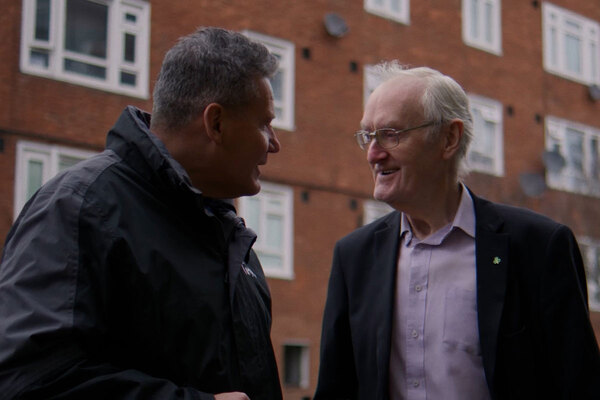

It is an interesting time to talk to Mr Hulme. Over the course of little more than a year, Hyde has taken a number of huge steps to articulate its ambitions and deliver on them. First up, it acquired Pinnacle Group, which delivers property management and community services across the UK. Next came a 50/50 joint venture with Pinnacle Investments designed to support Hyde in securing more institutional capital.
Both moves will play an important role in the success of the group’s new five-year strategic plan. To give a feel simply for the physical scale of the transformation, the group now employs more than 5,000 people (up from 1,400 before the acquisition of Pinnacle), owns or manages 125,000 homes, and provides housing, property and community services to more than 350,000 homes. Today it carries out 95% of repairs in-house.
In April 2025 Tower Hamlets Community Housing joined the Hyde Group. And just yesterday, 1,000-home Arhag Housing Association, which formed in 1979 as a response to the housing needs of refugees from Africa, announced that it will join the Hyde Group from 1 April this year as a subsidiary, with a focus on increasing its capacity to invest in existing homes and maintain a strong local presence in neighbourhoods.
Inside Housing sits down with Mr Hulme to understand the vision that is driving all this activity, and what that five-year strategic plan will mean for the future of one of the UK’s biggest social landlords. We also want to get an insight into how the wider policy and regulatory environment is affecting that thinking and planning (spoiler: there are some big issues Mr Hulme would like addressed).
Today’s location is a great place to start, because it embodies many of the themes and actions we will talk about today. The Myatts Field North estate was inherited as part of the Pinnacle Group acquisition.
Pinnacle was one of the partners in the £150m regeneration that delivered 808 homes on the estate and refurbished 170 more, between 2012 and 2017, along with the community centre we are having coffee in today. It now provides neighbourhood management services across the estate, which includes 247 homes for social rent, 146 for shared ownership, 357 sold on the open market and 172 refurbished pre-existing homes.
This leads us on to Hyde’s broader objectives. Pinnacle gives the landlord the kind of capability and reach that its new strategic plan explicitly sets out to achieve. The plan defines Hyde’s aim as delivering “end-to-end housing and community solutions” – in other words, the desire not just to deliver homes but also to influence places on a broader scale.
In turn, the acquisition ties into the group’s most prominent strategic objective: “to serve”. The other five objectives are to invest in homes, support communities, build homes, grow income and “empower our people”.
Let’s start with that first objective. “Our job is to serve,” Mr Hulme states bluntly. In practice, this means “if it goes wrong, it’s our responsibility to fix it. If you need help, it’s our responsibility to help.”
“Our neighbourhood team spend twice the amount of time in our estates as they used to. It’s made a massive difference”
Steps have already been taken to improve delivery, with two-thirds of staff now directly interacting with customers. Hyde estimates that its neighbourhoods model, introduced in January 2024, means its staff spend twice as much time with customers than in previous years.
“We’ve moved staff back onto our estates, our neighbourhood team spend twice the amount of time in our estates as they used to. It’s made a massive difference,” Mr Hulme says.
Overall satisfaction with Hyde’s services increased by almost five percentage points to 65.5% in 2024-25, and satisfaction with repairs jumped by more than eight percentage points to 76.4%, according to its 2024-25 tenant satisfaction measure scores. All its key indicators improved over the course of the year.
This might be good news, but the acquisition of Pinnacle Group (and indeed Pinnacle Investments) points to a desire to influence more than just the service to residents in their homes.
“What Pinnacle does for the first time is give us an end-to-end capability that we think is unparalleled and unique, and that capability is at a national level,” Mr Hulme explains.
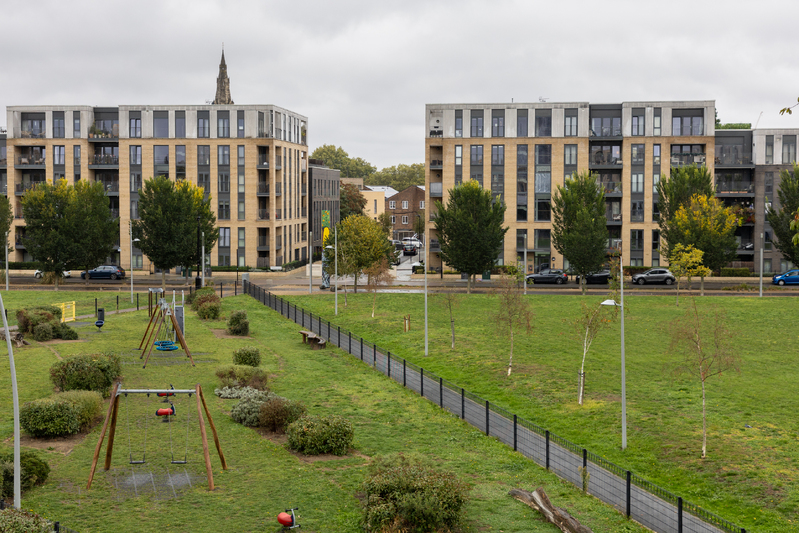
Myatts Field North played at least a small role in the decision to proceed; it was this estate that Hyde visited when it was considering the acquisition. Given the community centre has a green roof that anyone can stroll up (imagine a gentle ski slope running up one side of the building), it provided the team with a literal helicopter view of what a Pinnacle/Hyde collaboration could bring to an area.
“We have homes around here,” Mr Hulme says. “We worked with the local school here already. Our colleagues that support our charitable activities helped open the community centre. You can stand on the roof of this building and literally see our homes [and] Pinnacle’s homes. It just works.”
The words ‘end-to-end’ crop up again. It is worth pausing here to unpick exactly what they mean to Mr Hulme, because when it comes to Hyde they are about reimagining what the business can be and what it is capable of.
From a resident perspective, he says: “Whether it is something that’s happening in your home, the GP surgery you go to because your kids are sick, the school that your kids go to learn, if we can touch as many of those key moments [as possible] that’s powerful.”
Near Myatts Field, in Lambeth, Hyde provided a new GP surgery by converting one of its old offices. Today it offers 25,000 appointments a year. At its Rochester Riverside development, it built a new primary school with its partners.
Housing, though, remains the core business: “That’s the passion. Social housing is what we do. It’s why we exist. But, so often when it goes wrong, it isn’t necessarily the house that’s gone wrong. It’s that there’s a problem with the shop down the road, the school, youths hanging on the corner, whatever it might be.
“It’s wrong if you think that complying with a regulatory measure or legislative measure is success”
“The fact we can better intervene and support and provide continuity is attractive to us. It’s attractive to our customers. It’s attractive to our clients.”
This scale means that in many places Hyde is a significant employer or provides services to big employers. Mr Hulme asks: “Can we join the dots and better connect? How do we work together to get a better outcome [for communities]?”
The acquisition takes Hyde into other new territory as well, with Pinnacle providing landlord services (but not maintenance) to the Ministry of Defence’s homes. “So, whether you’re in the army, the navy, the RAF, if you’re living in army housing outside of the wire it will be a home that is managed by Pinnacle,” he says.
“We’re incredibly proud of that. It’s not social housing but the reason it exists is very similar.”
Add the joint venture partnership with Pinnacle Investments – with the aim of unlocking more institutional capital – to the overall mix, and the overarching strategy becomes even clearer.
“It’s the whole thing,” Mr Hulme says. “Part of our model is based on third-party capital. What [the acquisitions do] is give us capability, whether that’s land acquisition, planning, partnering and engaging customers to go through a regen or whatever it may be, all the way through to the landlord services and wraparound services to run the homes and ensure they are safe and decent and actually managing the... investor returns. It’s end-to-end.”
While this might be revolutionary for Hyde’s shape and ambition, there are numerous other external factors that have an impact on its capabilities.

Regulation is one. We’re speaking shortly after the first phase of Awaab’s Law came into force. Mr Hulme is confident not only that the landlord is “compliant today”, but also that it has stress-tested its systems “for double the volume in winter”.
He is similarly upbeat about the new Competence and Conduct Standard, which brings new requirements for qualifications for senior housing executives and managers.
“Getting people trained and qualified and investing in them is a good thing,” he points out, making the link to Hyde’s strategic plan and its commitment to empower staff.
“I do sometimes wonder if there are different qualifications we could do that might be more relevant to people’s jobs, but something that says ‘there is a base standard here’ is fundamentally a good thing.”
It is a similar story when it comes to hitting the government’s target to bring all social homes up to Energy Performance Certificate (EPC) C by 2030. “Just over eight out of 10 of our homes are already compliant. We only build to EPC A or what I call B+.”
Compliance, however, shouldn’t be the central goal or driver for landlords, Mr Hulme adds. “It’s wrong if you think that complying with a regulatory measure or legislative measure is success,” he states. “It’s good because we’re compliant, but it doesn’t necessarily mean it’s brilliant.”
Building climate resilience into homes and the broader living environment is as big a concern as an EPC rating, for instance. Among other things, this means “putting more trees into our new schemes... more trees on our existing estates, creating shaded areas, shaded walkways”.
One of Hyde’s key aims in its strategy is to build more homes. It has one of the biggest housing association pipelines in the UK: 7,705 homes between 2025 and 2030, according to Inside Housing’s 2025 Biggest Builders Survey.
With this strategic commitment to deliver, what are Mr Hulme’s thoughts on the Building Safety Regulator? The regulator has attracted early criticism for slowing down both building and improvement work due to overload. “We are learning how they work, they are learning how we work,” he says. “There are delays.”
While those delays cost time and money and “worsen outcomes for our customers in the short term”, Mr Hulme sounds like he has some sympathy for the task being undertaken. “Imagine building an entire brand-new organisation under a new regime – it’s hard and I think they are trying to get on top of it,” he says.
There is a little more challenge in the air when it comes to the Housing Ombudsman – or perhaps the way the ombudsman’s figures are interpreted.
“It costs Hyde, and therefore our customers, £500,000 a year to be a member of the ombudsman service,” he says. “Last year, the ombudsman told us we were wrong on 100 occasions.”
Of Hyde’s negative determinations, around 48% related to repairs in 2024-25. In 2024, it carried out 148,000 repairs jobs, up from 90,000 the year before.
“I don’t know another industry that could deliver a ratio that good,” Mr Hulme says. “In about 90% of them we had already agreed with the customer. We said, ‘Yes, you’re absolutely right, we got it wrong. Here’s what we are going to do to fix it. We’ll be back out tomorrow. Here’s some compensation. Let us apologise.’ Is that good value for £500,000? It doesn’t feel like it to me.”
He adds that he has some concerns about how long the ombudsman service takes to turn around some customer complaints. It would be wrong, however, to characterise this as full-blooded criticism of the service – the tone is more thoughtful than that. Mr Hulme talks a number of times about the desire to work continuously to improve efficiency – “remove the grit” – in his own organisation, and it is a similar tone he takes here.
For starters, he says there has been learning taken on board from ombudsman reports and “we really enjoy working with the ombudsman colleagues”. Ultimately, Mr Hulme says that scrutiny and challenge is a healthy two-way street. While regulators demand quality, “so do we. It works both ways.”
“I’d love to get to the place where for every home that we build, maybe one in every £4 is our capital and the other £3 comes from somebody else”
There are one or two cases that do rankle, however. At this point it is worth noting that Hyde was one of the driving forces behind a piece of work carried out last year by the G15 into rising assaults on housing staff – “one in 10 of our colleagues were verbally or physically threatened or assaulted in the last year”.
“There have been instances where our colleagues have been physically assaulted by a customer and the ombudsman has said that we are wrong. How can that ever be acceptable? I will never pay compensation for that.”
Hyde’s 2024-25 annual report states that the organisation will “appeal severe maladministration determinations where we believe the Housing Ombudsman Service fails to consider customers’ behaviour”.
There are also likely to be links between assaults on staff and anti-social behaviour on estates, Mr Hulme suggests. Perhaps because of his own background growing up on a council estate in Stoke-on-Trent, he picks his words carefully here and strongly emphasises that whether it is anti-social behaviour or assaults on staff, we are talking about a very small minority of people.
With a view to the next round of the Social and Affordable Homes Programme, Mr Hulme clearly has significant ambitions both for delivery and for how that delivery is done. “I’d love to get to the place where for every home that we build, maybe one in every £4 is our capital and the other £3 comes from somebody else.”
“I’m a charity, not a bank,” he adds. “My job is to serve outcomes, serve communities and serve customers.”
When people talk about innovation in the housing sector, it is not always about tech. This is the kind of model they should be looking at, Mr Hulme suggests. “I want to do homes and community and neighbourhood, support businesses and local schools. We want to do that end-to-end. That’s innovative. People are not thinking like that.”
After a tour of the estate, we stand on the green roof of the community centre, looking out over Myatts Field North and a vision for Hyde’s future. It is an organisation that has changed and adapted dramatically over the past 12 months. This is just the start of its five-year plan. Watch this space.
Sign up to Inside Housing’s Development and Finance newsletter
Sign up to Inside Housing’s weekly Development and Finance newsletter, featuring a round-up of business, development and regeneration news and analysis.
Already have an account? Click here to manage your newsletters.
Sign up for Housing 2026
Join us at Housing 2026 and hear from the sector’s most influential voices. Leading housing organisations curate their stages, showcasing the speakers and discussions that matter most.
Take part in purposeful, tech-enabled networking – see who’s attending, handpick the people you want to meet, and engage in meaningful, in-person conversations.
Connect with every key decision-maker under one roof, from local authorities and housing associations to investors, developers and operators.
Related stories