



You are viewing 1 of your 1 free articles
Community demolition
Residents in Lambeth have been fighting to stop 306-home Cressingham Gardens being demolished, which last month Lambeth Council decided to press ahead with.
Lambeth says replacing the homes with 464 new properties is the best possible option for the estate and point out there will be no loss of social housing.
But a local councillor and resident – a member of the Save Cressingham Gardens campaign group – are keen to explain what they believe is the human cost of knocking down an estate.



Scott Ainslee, Green councillor, Streatham
The councillor
“You can’t eat the orange, and throw the peel away – a man is not a piece of fruit.”
These days, whenever I think about London’s housing crisis, I find myself coming back to the words of Willy, from Arthur Miller’s Death of a Salesman.
Willy is demanding to be regarded as human worthy of compassion, and not simply a set of sales figures.
That’s what so many in Lambeth, such as the residents of under-threat estates like Cressingham Gardens, want too.
In their single-minded determination to demolish the estate, Lambeth councillors have reduced it to revenue and cost lines on its balance sheet – thus a person in a home becomes a statistical impediment to improving those numbers.
Even I, with barely a rudimentary understanding of the housing market, can see the real value of the land on which Cressingham Gardens Estate sits.
Situated at the top of Tulse Hill in Brockwell Park, the residents have one of London’s greatest green spaces as their back garden. Its views are easily the equal of Primrose Hill and Hampstead Heath, and if it’s up to Lambeth’s councillors, the property prices in the area will go that way too.
You don’t even have to cross the road to see Cressingham Gardens’ future.
“London, and Lambeth, needs to make up its mind about what it wants to be: a sterilised playground for the rich or a diverse, vibrant home to those who want to live here and participate in something special?”
On the much newer neighbouring Brockwell Gate development, a four-bedroom house is currently listed for sale on Foxtons’ website valued at over a million pounds.
A similar dwelling a few doors down sold for £860,000 just under a year ago. You don’t need me to tell you how far out of reach that is for ordinary people.
Despite impressions and accusations to the contrary, I’m able to recognise, and even muster some sympathy for, the fiscal bind that Lambeth finds itself in.
In the age of austerity many of the problems it faces have not been of its own making.
But it has lacked imagination in finding a solution to these problems and dismissed imaginative solutions offered by others.
Instead of working with the people, the council has put its lot in with developers, and bent to the needs of the housing market.
But the market is a blunt, brutal, unfeeling force.
Lambeth’s councillors may believe they’re doing the right thing, that full-scale redevelopment is the least bad option. But they are wrong.
London, and Lambeth, needs to make up its mind about what it wants to be: a sterilised playground for the rich or a diverse, vibrant home to those who want to live here and participate in something special? If we submit to the market, we are voting for the former.
Brockwell Gate is, as the name suggests, a private gated development, of the kind that Ian Blair, when he was deputy commissioner for the Metropolitan Police, described as ‘invidious for social cohesion’.
Cressingham, in contrast, was designed by Lambeth borough architect Edward Hollamby to foster community, to bring people together.
You only have to walk through the estate, or meet some of the campaigners fighting to save it, to see that is exactly what he has achieved. That’s what we need to keep fighting for.
Because a man – a person – is not a piece of fruit.
Scott Ainslie, Green councillor for Streatham’s St Leonard’s ward
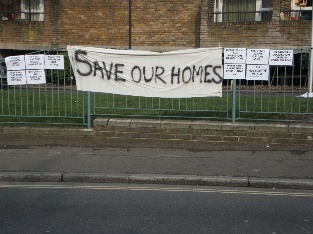
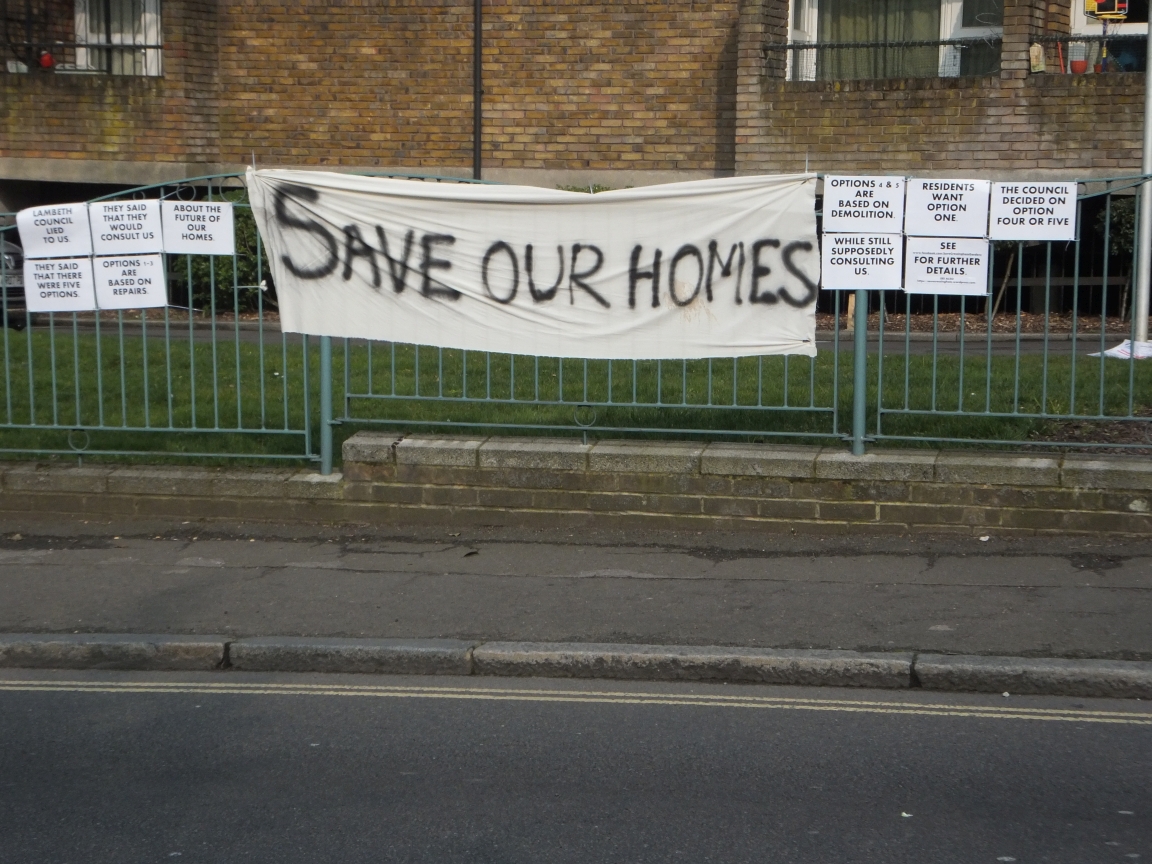
Tenants’ posters to save Cressingham Gardens (Ms Brockwell did not wish to be pictured)
The resident
“…A house is not a home…” according to Burt Bacharach’s song.
Nor is a council estate a community.
This estate will still exist – in a different shape – after regeneration, but I’m less optimistic about our community surviving in anything like its current form.
This isn’t a ‘sink estate’.
Crime levels here, year-on-year, are low for this borough.
Repairs are needed, and maintenance has been neglected, but walk around here and the impression given by the cleverly placed short blocks and pockets of green space is almost village-y in spite of relatively high density.
Many residents will be hit hard, even by sensitive and careful rehousing.
Just off the main road, up this short flight of steps and then another, is Hardel Walk.
This level includes family-sized maisonettes, built over one level of ordinary flats.
Kitchens are by the front door – you can empty your shopping bags almost as soon as you get home.
Front doors and kitchen windows face onto the walkway, maximising your chance of seeing callers, delivery people, or anyone up to mischief.
These were some of the first homes on the estate to be completed and into which young couples and families were moved.
On this row, three women in their 80s live side by side. They have names of their own, but I think of them as the Three Minxes.
If you met them, you’d understand why; their energy and sheer love of life puts many younger people to shame.
“Many residents will be hit hard, even by sensitive and careful rehousing.”
Their homes have been lovingly decorated and furnished, as you do when you put down roots. All three raised their children here, and one of them babysits her grandchildren, making it easier for her daughter to find somewhere affordable to live in the area.
All three Minxes would probably need to be in sheltered and supported housing if they didn’t have each other.
Two supported the third through the first years of recent widowhood.
They could do so because they’d already experienced it themselves and, being longstanding neighbours, it was no extra trouble and no burden.
One has hearing loss and isn’t confident being out after dark because of it, but another Minx is happy to accompany her.
Again, it’s no trouble – it’s just what you do for a friend.
They watch out for each other, take deliveries for each other, and can even split the cost of having their shopping delivered because they live so close.
They keep isolation and loneliness at bay, and keep each other younger and healthier than they might if further apart.
Can they ask to be rehoused so closely in the regenerated estate? No. Rehousing longstanding neighbours so that they remain neighbours isn’t recognised as a need.
Would their new neighbours be so willing to look out for them and help out? Maybe, but it wouldn’t feel the same.
They’d be on the receiving end of help instead of feeling like equals – from each according to their abilities, to each according to their needs.
I won’t claim that the entire estate is one big cosy community – it isn’t.
As with anywhere in London, you’ll find some people barely on nodding terms with neighbours after several years, but that makes the patches of neighbourliness more valuable, not less.
Ann Brockwell, Cressingham Gardens resident





Related stories







