You are viewing 1 of your 1 free articles
The new association of council housing directors reveals its plan of attack
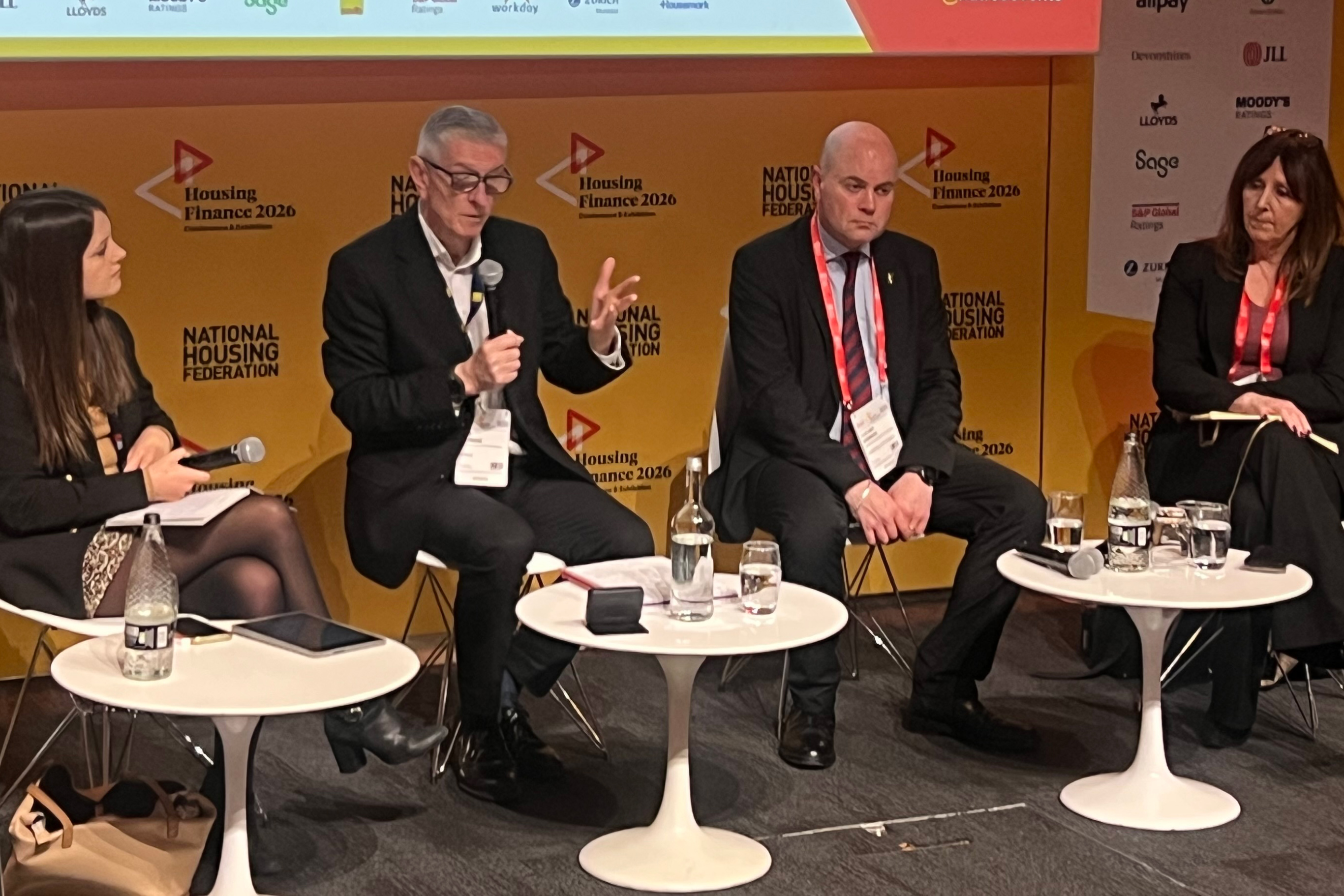
This week sees the official launch of the new Association of Directors of Housing. Chairs Glyn Halksworth and Hakeem Osinaike tell Martin Hilditch about how they are looking to deliver real change at a time when the job has rarely been bigger or more stretched


 The chairs of the Association of Directors of Housing set out their game plan and why the moment is right for a new voice in council housing #UKhousing
In recent years, the job of a local authority director of housing has been growing in complexity. The scale of the role is vast and the resources available are often scarce.
Many councils are wrestling with the financial and human cost of a temporary accommodation crisis that has pushed some to the brink of bankruptcy. Just a few weeks ago, the Office for Budget Responsibility warned that many council Housing Revenue Accounts (HRAs) are “effectively loss-making”, partly as a result of ballooning expenditure on repairs.
Directors of housing are also dealing with the introduction of a new consumer regulatory regime in England, with councils making up the lion’s share of the non-compliant grades from the Regulator of Social Housing (RSH) so far. Factor in housebuilding and regeneration, alongside local government reform, and you have something like a perfect storm.
Read more
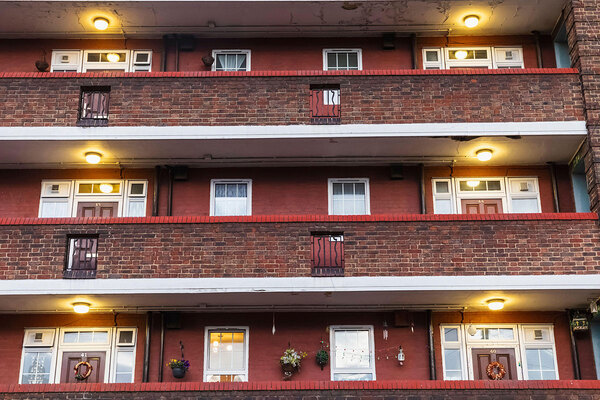


To help bring order to this melee, this week sees the official launch of a group set up by housing director for housing directors. The new Association of Directors of Housing (ADoH) is looking to step into the breach to become the leading professional voice for local authorities in England on housing and homelessness.
Inside Housing sat down with the co-chairs of the group, Hakeem Osinaike, strategic director of housing at Southwark Council, and Glyn Halksworth, director of regeneration, housing and regulatory services at Southend-on-Sea Council, to find out why the group has been set up and what they hope to achieve.
This is also an opportunity to find out a bit about what makes the co-chairs themselves tick, what they bring to the table and why they chose careers in council housing in the first place.
Mr Halksworth’s entire adult life has been a story of our failing housing system in one way or another. At university in Brighton he was involved in student politics and “the vast majority of my casework was housing”.
“We had some pretty roguish landlord behaviours, lots of poor student accommodation and a relatively expensive city as well,” he says. The story was about to get very personal, too.
“I got kicked out of university because I was homeless, and I ended up rough sleeping. I had addiction problems. There were a few lost years in some regards.”
Unsurprisingly, these experiences have helped “forge my subsequent career” and his approach to the job to this day. “It keeps me very grounded in terms of that strong sense of social justice that I hold dear in my career, and has very radically informed my approach to conversations with people and inclusion in lots of ways.”
Starting off working in drug and alcohol services, Mr Halksworth also worked in hostels, before becoming director of housing in Southend almost a decade ago.
While Mr Halksworth moved into housing from a health background, Mr Osinaike this year celebrates his 30th year in council housing, during which time he has worked for seven local authorities.
“There isn’t a part of a housing that I haven’t worked in at one level or another,” he says with a smile. His career started off working in housing complaints, which “gave me an eagle-eye view of all housing services, and it became clear to me that that was where I wanted to make my career”.
Since then, his experience has taken in pretty much the full gamut of council housing.
“My experience is varied across homelessness, temporary accommodation, allocations, housing management and development even,” he says. “I have learned a lot along the way about what ‘good’ looks like and when things aren’t correct, what that looks like as well.”
All of which brings us to the creation of ADoH. The first line of the membership pack refers to the difficulties directly, stating “we know the scale of the task has never been greater”.
Working in council housing at the moment is “very, very challenging, but at the same time exciting”, Mr Osinaike says.
Perhaps in the past there might have been times where the kinds of issues faced by directors of housing in London may have felt different from councils outside the capital, he suggests. But today “all of the national issues are now common”.

“We are all suffering with temporary accommodation costs, homelessness and demand. We are all struggling with our HRAs. It doesn’t matter where you are in the country, we are all facing the same things.
“So, in 2024, the discussion started about how local authorities across the country can support each other. It can sometimes be a very lonely job, because you are at the coal face, struggling with all the things you have to jump on. Finding support, finding somebody else in that situation, it’s helpful.”
Discussions within the Local Government Association (LGA) quickly morphed into the creation of the ADoH, a council housing version of the long-established Associations of Directors of Adult Social Services.
When directors of housing did bump into each other, the conversation would often turn to the multiple challenges they faced. There was a general feeling of “this [the collective challenge] is so enormous, this is so diverse, this is so complex... I need to share some ideas”, Mr Halksworth says.
“People were crying out for some space to talk to each other. We just didn’t have the focused time or space where we could do that,” he adds.
Things moved quickly from the initial conversations. By March last year, housing minister Matthew Pennycook was announcing government funding for ADoH at a council housing summit in Sheffield, saying it was “about time” it was created. A shadow board was formed, guided by Jo Allchurch, director of strategy, impact and operations, and this year a programme of work drawn up.
Now, the association is launching formally and opening its doors as widely as possible for members. After initial support from government and the LGA, from April this year it will be funded through local authority membership fees (£2,800 for a local authority without housing stock, and £3,000 for those who own homes).
ADoH’s topline is simple: to be that leading professional voice. It promises members “faster access to intelligence, stronger national influence and a trusted space to solve problems with peers who understand your challenges”.
ADoH’s strategic objectives
- To be the leading, independent voice of council housing and homelessness services to effect positive outcomes for communities
- To advocate for better housing standards and influence national and local policy decisions to drive systemic change across the housing sector
- To promote and deliver research, innovation and learning
- To promote and enhance leadership and management skills and capabilities
- To advocate for adequate and fair funding, powers and flexibilities to deliver and support the work of housing and homelessness services
There are four specific areas that ADoH will be particularly focused on. The first is homelessness and housing needs, with a committee chaired by Jo Wilkinson, chief officer for housing and property at Lancaster City Council.
“I think the homelessness side of local government – Hakeem used the word ‘lonely’ – I think it’s perhaps the loneliest place because you are so at the coal face a lot of the time,” Mr Halksworth reflects.
“You often don’t get that space to reflect and think about whether there is a different way to approach this wall of challenge which we’ve been faced with. That committee’s particular objective is to bring that conversation to the fore, facilitate that exchange of ideas and collectively bring some different ways of thinking.”
Given that “wall of challenge”, it is perhaps unsurprising to learn that when the homelessness committee last met, there were more than 60 councils in attendance. The idea is also that by “gathering that collective perspective”, ADoH can also act as a representative voice with the government when it comes to discussions about potential solutions.
As mentioned, councils have faced particular challenges when it comes to the introduction of consumer regulation and the impact improvement works are having on their finances. The second of ADoH’s committees is therefore focused on housing quality, standards and regulation. It is chaired by Kelly Deane, director of housing and public protection at Bournemouth, Christchurch and Poole Council.
One of the big advantages here is the ability for ADoH to interact with the regulator and pass on learning from members who have been through inspection. Mr Halksworth sees this interaction as being “a complicated area for the Regulator of Social Housing, too – they’ve not engaged with local authorities in the same way that they have with housing associations for very long, really”.
“Ultimately, the goal of this is to make sure we provide really good landlord services to our tenants,” Mr Halksworth says.
It is a pressing conversation for many councils, including his own in Southend, which received a non-compliant C3 grade in September last year following its inspection by the regulator, with the council not having “up-to-date information on the condition of most of its homes”.
“The reality is getting a C3 tells you an awful lot about what you’ve got to do that you can then share with others, in the same way that I will learn just as much from a C4 as a C1,” Mr Halksworth says.
“It’s the richness of the conversation and the exchange, and the [collective] conversations with the regulator are really helpful both ways as well.”
“If there was a time to be building new homes, it is now, because we are all struggling with homelessness, demand and temporary accommodation costs”
The next priority area, with a committee chaired by Lisa Michelson, service director for housing and strategy at Buckinghamshire Council, is local government reorganisation.
This is the process of streamlining local government by replacing the current two-tier system with new single-tier unitary authorities. Such a huge change brings a raft of challenges, from the process of integration to the worries and concerns of staff about what it means for their jobs (and issues of staff retention as a result).
“It’s a big issue and completely new to lots of people,” Mr Osinaike says. “There’s the issue of what’s happening to me personally, and then there is the issue of, ‘how do you even navigate this?’”
Mr Osinaike says he has had conversations with many housing staff about how they are “anxious and worried” about local government reorganisation. “Rather than being anxious, worried or, worse, panic, embrace it and try to influence it,” he advises.
For Mr Halksworth, the committee’s work is about helping people prepare for what the change looks and feels like “in anger”.
“That is really, really critical, because once it comes your way there is an enormous pace to it and you need to be ready,” he explains.
“Part of the reason you need to be ready is because, as we have discussed, there is so much other stuff going on as well. So, it cannot just take over everything else, because that carries on. It is how you accommodate all that other stuff while you’ve got this extraneous noise that you also need to be responding to and driving and influencing as well.”
The remaining committee is focused on development and regeneration, and is chaired by Naomi Morris, director of strategy, estate regeneration and regulatory compliance at Birmingham City Council. Delivery is the big issue here.
“If there was a time to be building new homes, it is now, because we are all struggling with homelessness, demand and temporary accommodation costs,” Mr Osinaike says.
The difficulty, of course, is delivery at a rate that will make a significant difference. The committee will look to highlight “how people are trying to crack the nut” as well as pulling together asks of government to help increase delivery.
Regeneration is another focus, and particularly the regeneration of high-rise buildings and large panel system buildings that were built in the 1960s and 1970s.
All of these are big pieces of work that lie ahead, which Inside Housing will continue to cover. This week, however, is all about the launch and the big picture. And much as we have been talking about significant difficulties that the whole sector faces, these are clearly two men who love their jobs and are up for the challenge.
“We do this because we love it,” Mr Halksworth says. “The fact we get paid for it is a bonus, but [being a director of housing] is a really instrumental role in our societies and we want to share that excitement.”
For someone who loves the sector, talking about and dealing with its challenges has a secondary motivation, he adds.
“Growing our prowess to do the right things and be providers of really good homes, all those things we need to do incredibly well, there’s a big bit there which is about developing the sector, and attracting, retaining and developing talent.”
Big plans and ambitions for the future, then. If ADoH succeeds in its mission, council housing will once again become a byword for quality and there will be a lot more of it. The scale of the challenge housing directors face is vast, but so are the possibilities.
Sign up to Inside Housing’s Council Focus newsletter
Sign up to Inside Housing’s weekly Council Focus newsletter, featuring the latest affordable housing news focused on local authorities delivered to your inbox.
Click here to register and receive the Council Focus newsletter straight to your inbox.
And subscribe to Inside Housing by clicking here.
Already have an account? Click here to manage your newsletters.
Sign up for Housing 2026
Join us at Housing 2026 and hear from the sector’s most influential voices. Leading housing organisations curate their stages, showcasing the speakers and discussions that matter most.
Take part in purposeful, tech-enabled networking – see who’s attending, handpick the people you want to meet, and engage in meaningful, in-person conversations.
Connect with every key decision-maker under one roof, from local authorities and housing associations to investors, developers and operators.
Related stories