You are viewing 1 of your 1 free articles
Stopping ASB before it starts
While impending legal reforms will change the way housing associations deal with anti-social behaviour cases, Laurna Robertson finds out how one landlord hopes to change young people’s attitudes and stop the problem before it starts



Source: Shutterstock
Ten young people are glued to an animated film. As they watch, a cartoon goth girl is being attacked. Blow after blow is delivered, and the small audience gatherered in the Eccles Fire Station in Greater Manchester gasps in shock, mouths covered in horror and eyes protected from the unfolding scene of merciless violence.
Sophie Lancaster, a 20-year-old student, was beaten so ferociously by a group of male teenagers in a Lancashire park in 2007 that she lay in a coma for 13 days before passing away. The reason for the attack? She dressed alternatively. Two teenage boys were given life sentences for her murder, and another three were convicted of greivous bodily harm.
If the fact that she was a ‘goth’ or ‘mosher’ numbed any of this group of young people to the attack previously, having watched how the incident unfolded in an animation created to educate, and hearing about her mother Sylvia’s ordeal of finding her daughter in hospital with trainer prints all over her face, changed that.
Which is a good thing, because the young people gathered in this dusty and rather chilly classroom have been selected to take part because they are at risk of criminality or violence. The event is part of a programme called Change Your Choices, organised by the charity the Prince’s Trust, the Greater Manchester Fire and Rescue Service and 14,600-home City West Housing Trust (CWHT) to learn about the true impact of violence and anti-social behaviour (ASB).
“Everyone always blames the kids, but the real damage is done by people who are predominantly on their own in flats.”
Carol Mawers, City West tenant and ASB victim, aged 52
The young people were chosen to take part by City West’s neighbourhood officers and partner agencies such as the police and Salford City Council’s youth offending service.
Relaying the horrific details of how her daughter died is a technique Sylvia Lancaster uses during the youth work sessions she and others run through the Sophie Lancaster Foundation, with the hope it shocks the youngsters enough that they challenge their preconceptions.
Along with ‘not sanitising the real story’, Sylvia, who has been a youth worker for 30 years, hopes to tackle any prejudice. Gauging by the rapt attention of the young people in the room, she certainly managed the first part of her task. Whether the £800 that City West spent on this day-long workshop prompted a permanent transformation for these young people is more difficult to verify.
‘The thought of changing just one young person’s mindset long-term is enough to keep me trying to break down the continuing prejudice against alternative subcultures,’ says Ms Lancaster, on the phone after the training. She was unable to attend the workshop, but left it in the capable hands of Sophie’s friend, Stacey Elder, and family friend, Kate Conboy-Greenwood. ‘The thought of preventing another Sophie is never far from my mind.’

Source: Housemark
Assessing risk
Sophie’s case is extreme, and goes well beyond the bounds of anti-social behaviour. The young people in attendance today have been selected because they had been involved in anti-social behaviour such as vandalising commercial property, playing pranks on the emergency services, been excluded from school due to unacceptable behaviour, or were deemed at risk of becoming involved with ASB.
But hate crimes, whether based on ethnicity, sexuality or being part of an alternative subculture, are something that landlords’ ASB teams will have to tackle.
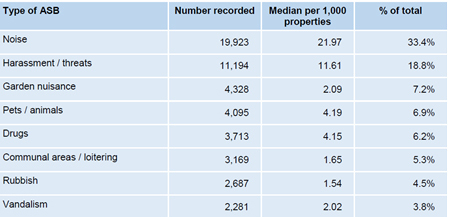
It is usually recorded within harassment and threats, the second most common form of ASB social landlords have to deal with. According to Housemark’s ASB benchmarking report for 2013/14, there were 11,194 incidents of this type of ASB recorded by the 72 landlords who submitted data, and it comes second only to noise complaints with 19,923 incidents (see chart).
What the young people thought
‘I found the presentation about how ASB can be linked to mental health really interesting. Before today, I didn’t really know about the effects of ASB on the individual people, so I’ll be taking that with me.’
Lewis Jones, 24
‘I grew up near to where the Sophie Lancaster incident took place and a lot of my friends knew her. The impact of the incident on the local community spread and it’s great that the foundation continues to raise awareness about it. I found the presentation very moving.’
Liam Kubler, 18
‘I’m glad I learned about what ASB is, how it can affect you and how persistent it can be. I normally listen to my music quite loud at all hours, but after today, I’ll definitely turn it down when my mum asks.’
Nic Powrie, 21
‘Before, if I’d seen someone abusing an emo, I wouldn’t have stepped in, but I would say something after today. Hearing real-life stories like Sophie Lancaster’s make a difference.’
Georgina Lewis, 22
Although there is no overarching government data breaking down anti-social behaviour, the most recent research showed that ASB incidents recorded by the police and the British Transport Police decreased by 6% compared with the previous year, with 2.1 million incidents in the year to June 2014. The figures may be going down (experts put this down to a combination of the police taking ASB more seriously and more consistent recording of the statistics), but the cost for landlords is still substantial. Housemark, in the same report, estimates that nationwide they spent £295m tackling ASB in 2012/13.
Eamon Lynch, managing director of Resolve Anti-Social Behaviour (RASB), formerly known as Social Landlords Crime and Nuisance Group, says without more in-depth nationwide figures, it is hard for social landlords to know exactly how to target the expensive issue, which is typically one of the big issues for tenants, along with repairs, financial concerns and welfare reform.
Early intervention
However, the Housemark survey showed that early intervention is the main action taken by landlords. Eviction of the responsible residents was the end result in less than 1% of all cases for 2013/14.
“Agencies in the area made savings in the region of £20,000 in the 12 months that followed the training”
Matt Jones, assistant director of communities and neighbourhoods, City West
City West’s experience echoes the national trends. Of the 800 cases of ASB it dealth with in 2013, 90% were resolved without legal procedures, with around 80 injunctions and around eight evictions.
However, injunctions could become a more popular option after this month when the Anti-Social Behaviour, Crime and Policing Act 2014 will change the way they work. Courts will be able to issue injunctions to anyone 10 years’ old or above who is ‘engaged or threatens to engage in anti-social behaviour’, whereas previously injunctions only applied to anyone 18 years old or above. Yet, without an improvement in the data collected nationwide, Mr Lynch believes it will be hard to monitor whether the reforms have been successful at preventing ASB and also difficult to know how ASB strategies should be adapted for best results.
Matt Jones, assistant director of communities and neighbourhoods for CWHT, says the landlord has a four pronged approach to dealing with ASB; prevention, early intervention, sharp enforcement and rehabilitation. Today’s training day for the group of 10 young people falls into the prevention category, but this wasn’t the first group of youths the landlord has worked with.

Source: Housemark
He says: ‘From 2012, we’ve run one-week sessions for young people who are currently, or have been, involved in ASB. Unlike the Prince’s Trust training, it focuses on children of our tenants and those with a neighbourhood connection.’
Prevention and early intervention work sound good on paper, but how does CWHT show results?
‘Working with our partners, we found that in the areas where we had run the sessions, there were significant shifts in attitudes and that associated agencies in the area made savings in the region of £20,000 in the 12 months that followed the training.’ He added that in one of the key areas it has been targeting, Swinton, youth-related ASB has dropped by 90% since April 2013.
Today’s training went one step further – it aimed to deal with the problem before it starts. Most of the group of 10 are currently social tenants, while the others suggested they could be in the future. Participants are identified by the Prince’s Trust itself and, although none are presently CWHT tenants, Mr Jones says it is paying for the training under the landlord’s ‘commitment to neighbourhoods’. A second session is planned this month.
Changing attitudes
When in the midst of a group of young people learning about ASB, it is easy to see how education is key to changing attitudes and providing space for reflection on the subject could be part of any winning strategy. At first, Sylvia Lancaster’s group seemed to be lethargic and shy. But the group opened up as they grew more comfortable with City West’s staff, who are today represented by Leanne Shone, projects officer, and Kristian Thew, anti-social behaviour officer.
Alongside hate crimes, the young people listened to presentations about how mental health is affected by ASB, heard from the fire brigade about the harm ASB can do, discovered how the landlord deals with ASB cases and they heard an emotional presentation from a former ASB victim and City West tenant, Carol Mawers, aged 52.
“The fact that this is focused and targeted at young people who could be at risk of getting involved in ASB shows a great deal of insight from the landlord”
Eamon Lynch, managing director of Resolve Anti-Social Behaviour
All doodles are abandoned while Mrs Mawers explained how she thought she was moving into her dream home, but in fact was about to embark on a living nightmare.
She says: ‘I moved into my new home close to St Mary’s Park in Manchester five years ago and thought it was a dream move as it was close to my grandkids’ school and was in a beautiful area.’
However, it didn’t take long for her to realise she’d been moved next door to someone who was involved with drugs. This meant her back garden was strewn with needles, her house was raided several times by people associated with the drug addict next door, and there was frequent threatening behaviour against, and noise from, her neighbour and his acquaintances. During the three-year period that she kept a diary documenting what was going on for City West, she developed agoraphobia.
Part of the City West early intervention strategy is to provide mentors for people who are suffering from ASB issues and, due to her ordeal, Mrs Mawers decided to get involved. Interestingly, she thinks today’s session is targeting the wrong group.
‘I’ve had about 20 mentees over two years and I can say, from that experience, it’s not young people who are causing a lot of the

problems,’ she says. ‘It tends to be single people between 30 and 55 who have come out of relationships and are either addicts, or are causing problems due to noise complaints, particularly with music. Everyone always blames the kids, but the real damage is done by people who are predominantly on their own in flats.’
However, Mr Lynch says that City West’s approach is uncommon and innovative, compared to the 300 housing members in the RASB group.
‘While many landlords will go into schools to discuss ASB and provide focus programmes for applicants about what it’s like to be a tenant, the fact that this is focused and targeted at young people who could be at risk of getting involved in ASB shows a great deal of insight from the landlord,’ he adds.
City West and the other organisations that made today’s training session possible have come up with bold preventative training, which could be easily imitated across the country. Judged by the change in the group’s attitude today, it could be a good investment.





Related stories