You are viewing 1 of your 1 free articles
New report calls for government-backed ‘loan-to-own’ scheme for first-time buyers
The authors of a new report are calling for a developer-funded, government-backed scheme to help first-time buyers (FTBs) get on the property ladder.


 New report calls for government-backed 'loan-to-own' scheme for first-time buyers #UKhousing
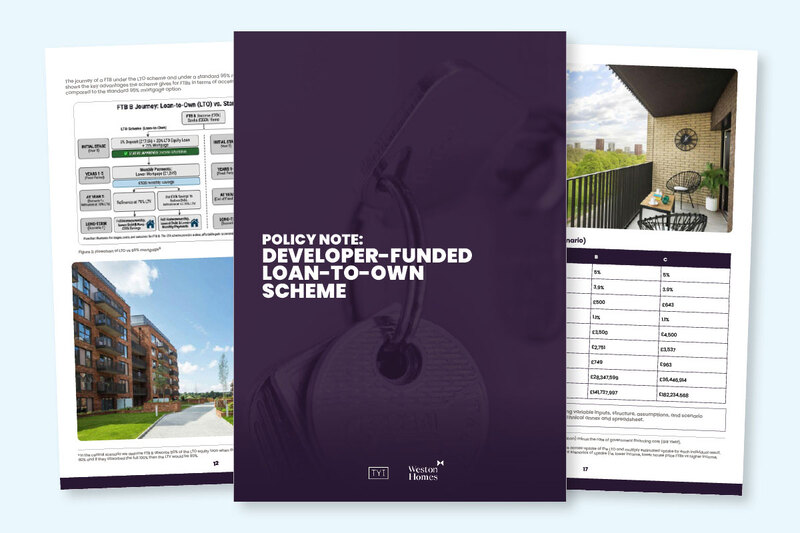
The report, by TYI Group and Weston Homes, is calling for a ‘loan-to-own’ scheme to help FTBs who struggle with meeting larger deposit requirements.
Launched in parliament yesterday, the report argues that the lack of such a scheme harms attempts to increase housebuilding numbers, potentially endangering the target of 1.5 million new homes this parliament.
Bob Weston, chair of Weston Homes, explained: “The lack of potential FTB customers also means we cannot build as many homes as we’d like to – or as fast.
“There needs to be sufficient demand for the industry to deliver. But they can only build when they can sell.
“House builders deliver around one new affordable home for every two private dwellings built. A buoyant housing market is critical to the housebuilding cycle.”
Read more



The scheme works by providing a loan covering up to 20% of the value of the property. The government provides the loan and it is interest-free for the FTB for the first five years.
However, developers pay a 5% coupon annually for the first five years to cover the cost.
After five years, FTBs are expected to refinance and likely either fully or partially absorb the 20% equity loan into their existing mortgage (including any increase in the value of the 20% equity that has occurred).
If any outstanding amount of the equity loan is not absorbed, the FTB will pay interest on this starting at 3% in year six, before being uprated by Retail Price Index for each subsequent year.
The report’s authors believe the policy proposal “should therefore be fiscally neutral or even generate revenue for the government”.
As an example, the report sets out how a FTB with a £70,000 household income purchasing a £350,000 property would be unable to buy the house with a standard 95% mortgage, as they exceed the income multiple of 4.5 often specified by banks. Loan-to-own would, however, make this purchase feasible.
The modelling indicates that the same FTB will be £500 per month better off every month in the first five years compared to if they had a 95% mortgage.
At the same time, there would be an estimated minimum of 70,000 FTB transactions if the policy were introduced today.
The government would gain almost £30m in additional revenue annually from the developers’ coupon payments. It would also gain from any increase in house prices and receive revenue after the first five years from FTBs paying interest.
According to a recent analysis by Halifax, the number of FTBs stepping onto the property ladder rose to 341,068 last year, up 19% compared to 2023.
FTBs made up over half (54%) of all home purchases made with a mortgage last year, the biggest majority on record. But the average deposit was £61,090, and the average FTB typically paid £311,034 for their first home.
Weston Homes’ own research shows 79% of FTBs relied on the ‘bank of mum and dad’ in the last 12 months.
Mr Weston added: “Every week, many potential FTBs are visiting our sales offices. There is a strong demand for homeownership rather than paying [for] exorbitant private rental or staying at home with their parents into their 30s.
“But consistently, the primary reason why most cannot afford to buy is due to having insufficient savings for a deposit.
“In order to get the country’s developers housebuilding again, Weston Homes believes the key missing link is that we need to take action to help FTBs secure access to housing credit and deposits.
“That’s why we’re calling for the creation of a new form of home purchase assistance initiative.”
The latest report comes after Inside Housing Living reported recently how house builders are increasingly targeting big families and affluent households as FTBs are priced out.
Jethro Elsden, chief economist at TYI, added: “Our analysis shows that supporting FTBs in accessing housing finance in a targeted, fiscally responsible way can have a meaningful impact and not only help more FTBs get on the housing ladder but also work hand in hand with supply-side reforms to boost the delivery of new homes.
“This scheme demonstrates that it is possible to unlock access to homeownership, support market liquidity and accelerate build-out rates while remaining cost-neutral, or better, for the taxpayer.”
Sign up to Inside Housing’s Daily News bulletin
Sign up to Inside Housing’s Daily News bulletin, featuring the latest social housing news delivered to your inbox.
Click here to register and receive the Daily News bulletin straight to your inbox.
And subscribe to Inside Housing by clicking here.
Already have an account? Click here to manage your newsletters.
Sign up for Housing 2026
Join us at Housing 2026 and hear from the sector’s most influential voices. Leading housing organisations curate their stages, showcasing the speakers and discussions that matter most.
Take part in purposeful, tech-enabled networking – see who’s attending, handpick the people you want to meet, and engage in meaningful, in-person conversations.
Connect with every key decision-maker under one roof, from local authorities and housing associations to investors, developers and operators.
Related stories