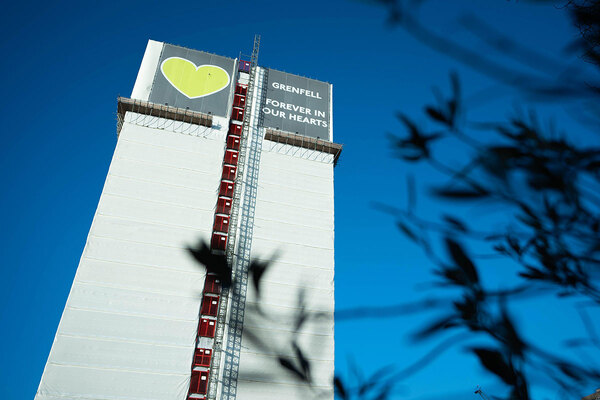
Senior civil servant feared ‘panicking’ DCLG would ‘comprehensively mess up’ Grenfell response
A senior Home Office civil servant feared the Department for Communities and Local Government (DCLG) would “comprehensively mess up” the response to the Grenfell Tower fire if it was left in charge.


 A senior Home Office civil servant feared the Department for Communities and Local Government (DCLG) would “comprehensively mess up” the response to the Grenfell Tower fire if it was left in charge #UKhousing
An email from Sir Philip Rutnam, permanent secretary to the Home Office at the time, was disclosed to the inquiry into the fire today, which showed he feared senior figures at DCLG (since rebranded the Department for Levelling Up, Housing and Communities), were “at risk of panicking”.
The email was sent at 7am on 15 June, the day after the fire, and came amid growing concern from the highest levels of government that the humanitarian response to the devastating fire was being mishandled.
The inquiry previously heard that DCLG, which was supposed to provide a liaison between central and local government during an emergency, failed to realise that the Royal Borough of Kensington and Chelsea (RBKC) was struggling to cope with the immediate aftermath of the fire.
Nicholas Holgate, its chief executive at the time, had elected not to call for outside help, saying: “That looks like we can’t cope”. However, the council had struggled to find accommodation or provide information to those affected by the blaze as a result.
Read more

This was becoming apparent in media coverage by 15 June. Sir Philip wrote: “I’m worried for the sake of the government as a whole what will happen if CLG do start taking the lead. On the basis of yesterday there is a real risk they will comprehensively mess it up.
“Both [Sajid Javid, communities secretary] and [Melanie Dawes, the permanent secretary] seemed, frankly, to be at risk of panicking.”
He also said the “mood on this incident… could worsen significantly if the news on fatalities gets a lot worse”. “This could well become a national tragedy of the first order,” he wrote, suggesting the need for “a single calm lead across government”.
“Do you know what might have given Sir Philip Rutnam cause to harbour the concerns he expresses there?” Richard Millett QC, lead counsel to the inquiry, asked Ms Dawes, who gave evidence today.
“I think it was the conversation I had with him on the Wednesday evening,” she said. “And that conversation was about the public inquiry. We believed we needed a public inquiry; we believed we needed it to be set up as quickly as possible.
“I had discussed that with Sue Gray [then director general for propriety and ethics] at the Cabinet Office… Philip was of the view that this would not be a good idea, and that is what I think he means by me and my secretary of state panicking.”
She said that “a week or so after the fire… everybody was rather glad that we’d been in charge”.
She added that the public inquiry was suggested by Helen MacNamara, then director general for housing, alongside Mr Javid.
The inquiry previously heard that the office of Theresa May, the prime minister at the time, asked officials at DCLG to provide them with a briefing about its actions and the situation on the ground on the morning of 15 June, asking for it to be delivered by 2pm.
A one-page document was sent by 3pm, but referred throughout to “Grenfell House” rather than Grenfell Tower.
“At risk of pedantry, it also doesn’t refer to the building correctly, does it?” asked Mr Millett.
“No it doesn’t, and I find that… very jarring and I’m sure that those directly involved in the fire must find it potentially very offensive and very difficult and I’m very sorry about that. It’s an oversight which I can’t really explain,” she said.
“Does it tell us anything about the degree of engagement of your officials?” asked Mr Millett.
“No, I don’t think so, but it perhaps speaks to a certain level of stretch that was going on in the teams. This doesn’t look to me like a note that’s had a great deal of senior oversight or checking,” she said.
As the inquiry previously heard, Ms Dawes had contacted RBKC’s Mr Holgate on the morning of the fire, asking him to “let us know – as and when is helpful – whether there is anything we can do”.
When he responded, less than two minutes later, to say “plenty of blue light support at present”, it appears Ms Dawes and her colleagues were content to assume he did not need additional support.
Civil servants prepared a briefing on RBKC, which noted that Mr Holgate had “previously worked in [the Treasury]” alongside Ms Dawes and that the department “has a very good relationship” with him as a result.
“Was it the case that you were more inclined to give him the benefit of the doubt or perhaps be more generous towards his management of the response than you otherwise would have been had you not known him?” asked Mr Millett.
“No, I don’t think that is the case at all,” replied Ms Dawes.
Ms Dawes said she had assumed the borough was relying on London-wide support arrangements available during an emergency and was not aware until later that Mr Holgate had declined to call for them. “I don’t think any borough could have coped with this on their own,” she said.
She later accepted this was a weakness in the department’s response.
“We were relying on [the support of other London boroughs], but we weren’t looking to see whether it had happened,” she said. “I think that’s one of the big gaps that I feel Jo [Farrar, who was the director general for local government and public services at DCLG at the time] and I and others didn’t fill in those early days.”
An email from another civil servant, at 10.30am on the day of the fire, referred to “chaos and hyperactivity in the Department this morning”, although Ms Dawes denied this was a description of its response.
“There was a lot going on, and we had a lot that we needed to do… but no, I don’t think it was chaotic or hyperactive,” she said.
After emailing him in the morning of the first day after the fire, Ms Dawes subsequently struggled to get in touch with Mr Holgate. The department was reliant on media reports for basic information, such as whether or not the tower was owned by the council.
“Did the fact that there were problems getting through to [RBKC], necessitating reliance by the department on media reports, hamper the ability of the department to obtain reliable and up-to-date information?” asked Mr Millett.
Ms Dawes said that information remained “extremely hard to find” right into the weekend, which was “one of the major problems” with the response.
On the evening of 16 June, two days after the fire, she assured Jeremy Heywood, the head of the civil service at the time, that all displaced residents, which included 845 from the low-rises surrounding the fire, were “all in hotels or in some cases still in rest centre if that’s their preference”, asserting that “none were on the streets”.
In fact, the inquiry has heard that several residents did sleep rough after the fire, after being told they were not allowed to return to their homes in the police cordon.
Asked where she had got this information from, she said: “I must have known that that was the case, particularly given that I responded so quickly, or at least I must have been told that that was the case.”
Ms Dawes said the department was not sufficiently prepared to react to a disaster where so many people lost their homes.
“The planning hadn’t been done on either response or recovery, really, in my opinion,” she said. “And so there was nothing really for us to be drawing on, and the Home Office weren’t really drawing on anything either.
“So what we did was simply try to manage and listen, to deal with whatever information we had, and to do whatever we could to help. But a bit more advanced planning and preparation would have helped us. There’s no question in my mind about that.”
Ms Dawes also expressed concern about the response of the Kensington and Chelsea Tenant Management Organisation (KCTMO), the arm’s-length body which managed the council’s housing properties.
“The leadership of the TMO just wasn’t working and somehow wasn’t managing to communicate with residents and wasn’t present on the ground,” she said.
She said the department was seeking to “orchestrate a change of leadership in the TMO”, but did not have a clear route to do so immediately.
“There just wasn’t any leadership from the TMO as perceived by those who would have expected them to be on the end of the phone, coming forward with a plan, knowing where their tenants were, communicating with those tenants and explaining what the situation was, and, as a result, people just didn’t know what was going on,” she said.
Ms Dawes said she believed new measures needed to be developed to allow central government to intervene if a council was struggling to cope with a disaster and not calling for support.
But she said these would need to be designed “carefully” to avoid central government being “too overbearing of a council that was actually doing a good job”.
At the end of her evidence she said she “deeply regrets” that “it took too long for us all to realise” there were problems with the response and then “quite a long time to sort and correct”.
Ms Dawes’ evidence concludes this module of the inquiry. It will not sit next week, but will resume on 6 June, with evidence from experts relating to a range of subject matters from the inquiry’s six modules.
It will then move to factual evidence about the precise circumstances of each victim’s death, before concluding its oral evidence completely in mid- to late July.
Sign up for our weekly Grenfell Inquiry newsletter
Each week we send out a newsletter rounding up the key news from the Grenfell Inquiry, along with the headlines from the week
Already have an account? Click here to manage your newsletters
Related stories