All in a day’s work
Front line housing workers face danger on a daily basis but what kind of abuse do they suffer and how often? Inside Housing conducted two exclusive surveys to find out. Lydia Stockdale reports on the shocking results


Spat at and slapped. Bitten. Punched. Forced to the ground and beaten. Every day in the UK a front line housing worker is falling victim to this kind of violent assault.
As the public face of social landlords, they are the ones who become a target for frustrated residents when tensions run high.
Attacks are sometimes brutal. A housing officer working in the south east of England, for example, recalls how one attack inflicted injuries requiring a trip to accident and emergency and 40 stitches.
Threats are even more frequent. Some front line workers have been warned their legs will be broken; others have been told: ‘You’re dead’.
‘I have to make a risk assessment mentally before every home, scheme or estate visit,’ explains one neighbourhood officer. ‘You do have to keep on your toes as you don’t know what could happen any day you are at work,’ says another.
Seeking the truth
Now, for the first time, research has revealed quite how often housing staff are being verbally and physically assaulted each year across the UK. Over the past two months Inside Housing has conducted an extensive investigation via freedom of information requests to local authorities and questionnaires emailed to housing associations. The results raise serious questions about the way providers protect their staff and whether they are failing to record problems that have the potential to escalate.

More than 220 councils, arm’s-length management organisations and housing associations in England, Northern Ireland, Scotland and Wales, answered our questions. They show that during the first three months of this year, an average of 10 physical assaults was reported by front line workers every week
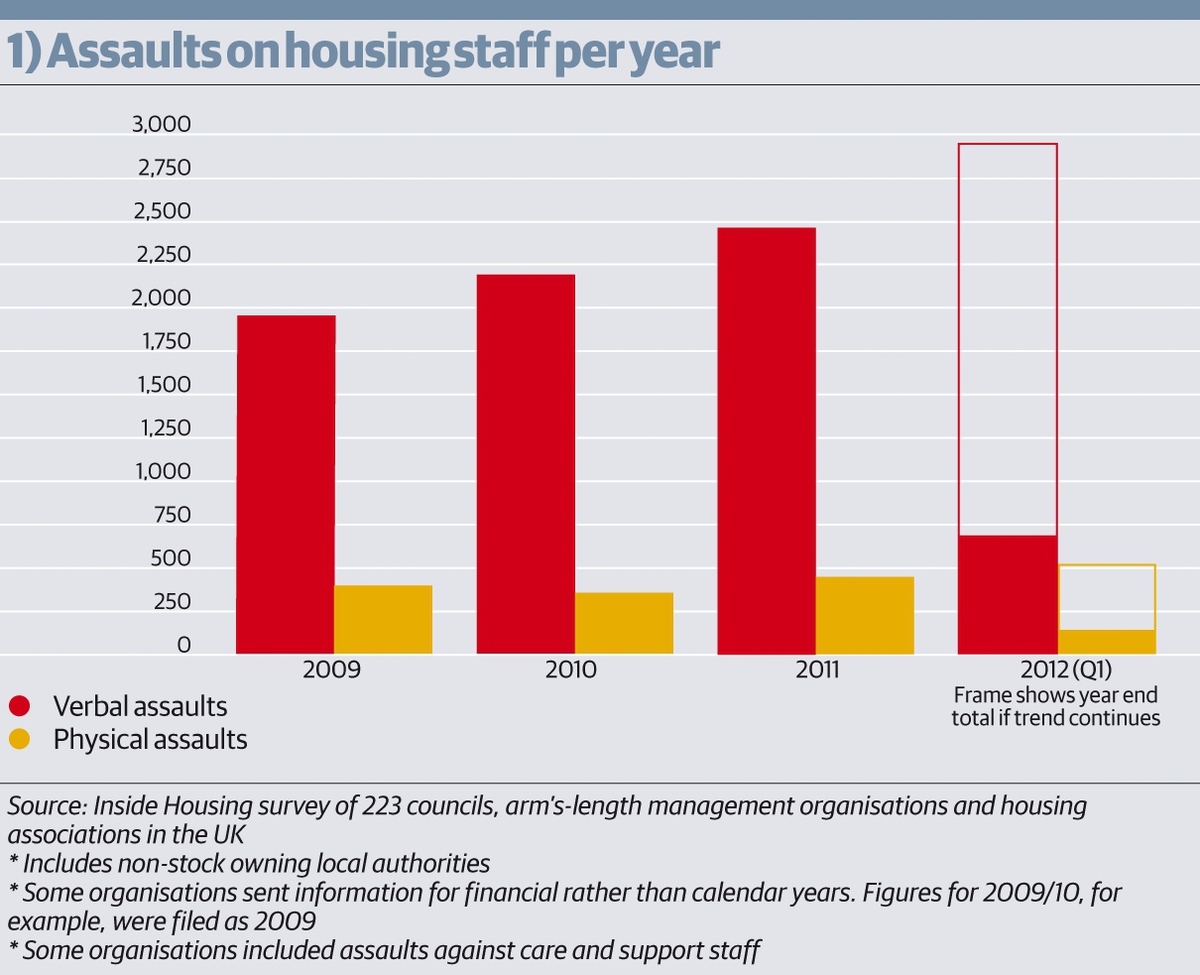
The research also reveals the number of assaults that occurred between January 2009 and the end of March this year. There were 8,898 verbal and physical assaults reported by housing staff of the 223 organisations that responded to our requests - roughly eight a day across the UK.
Around 1,350 of those assaults against housing staff were physical attacks - more than one a day - with the remainder involving verbal abuse. Perhaps most worryingly, the number recorded has been rising year-on-year. In 2011, landlords reported 2,480 verbal assaults, which was a 13 per cent increase on the number logged in 2010. There was an even larger jump in the number of physical attacks recorded: 483 physical assaults were reported in 2011 - a 35 per cent rise on the previous year.
So what is happening here? Why are housing’s front line workers apparently bearing the brunt of more aggression, and could the problem be much greater than even these figures would suggest?
Scratch the surface, and it is immediately apparent that the number of assaults that have recently been reported could still be a gross underestimate of the true number of violent incidents that have taken place.
Reporting failure
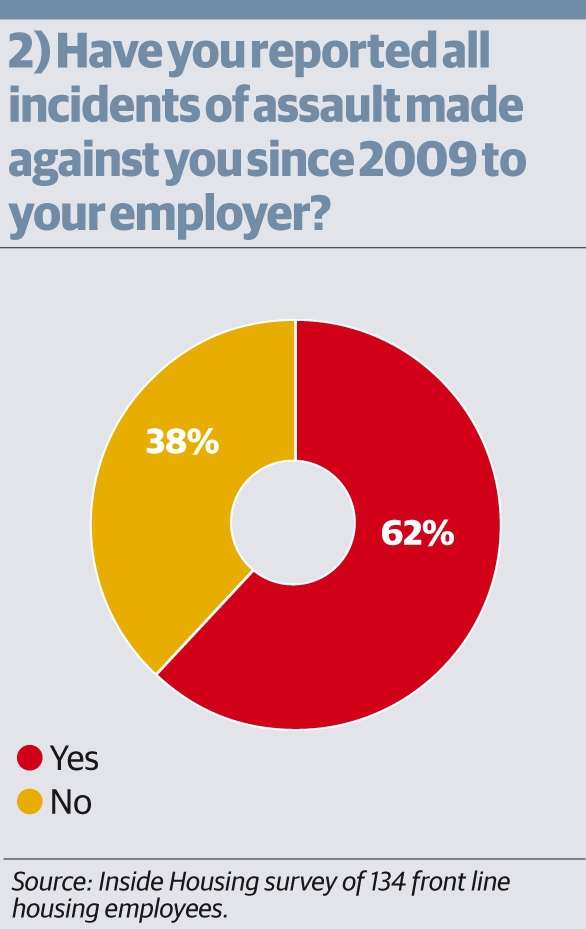
A separate, anonymous survey aimed specifically at front line workers, conducted by Inside Housing between April and May this year, found that more than a third of the 134 housing workers who responded do not report all assaults to their employer.
One housing officer working in England’s north west sums up the situation by stating simply that assaults against them have been ‘too numerous to mention’.
More than one tenth of those who completed our online survey - the vast majority of whom are housing officers or managers - have been physically assaulted since the start of 2009. They provided sometimes harrowing details of their experiences.
‘During a scheduled visit, the tenant got upset and followed me outside, shouting abuse. They then pushed me to the floor, got on top of me and began hitting me with my leather case,’ recalls one officer working in the east midlands.
Eight per cent of respondents have had a weapon used against them. One housing employee who specialises in anti-social behaviour had a knife thrown at them. Another, a project surveyor, was actually attacked by a tenant with a blade.
Others have been threatened with an array of objects including hammers, garden rakes, hockey sticks, tennis rackets and spades.

Six per cent have been taken hostage, most often trapped in a tenant’s home against their will. One London housing manager recalls how they were pushed into a resident’s flat, who then locked the door. The police had to come to make him open it.
A housing officer from the east midlands had a similar experience. They were called to the home of a tenant who was ‘causing trouble with neighbours’. The tenant locked the door, and ‘put the keys down her knickers’, the officer was then trapped for 45 minutes until the police arrived.
One per cent of survey respondents have been sexually assaulted while doing their job since the beginning of 2009, and a massive 84 per cent have been verbally assaulted, including incidents of racial abuse.
Verbal assaults are the most common - so regular, in fact, that many front line housing workers have become so used to them, they barely seem to notice. ‘I find we are all becoming increasingly tolerant of unacceptable behaviour and aggression,’ states one repairs and maintenance worker.
Sometimes verbal abuse goes a step further, though, taking the form of threats to housing staff and their relatives. ‘You go after my family and I’ll go after yours,’ a tenant told an ASB officer based in the west midlands.
‘A resident said he would kill me if he was evicted,’ says another, who works in the north east.
Nearly one fifth of those who completed our employee survey have received similar threats, but in writing. ‘I do hope your home address is in the public domain. If it is, expect a visit,’ said a letter received by one tenant participation manager, who remembers being ‘terrified’.
Not all messages are written in an email or on paper - some are plastered across neighbourhoods in spray paint. ‘My car was attacked, all four tyres were slashed. A couple of days later obscene graffiti, naming me, was painted on fences and sheds on the estate that I manage,’ recalls a housing manager working in the south west.
Sympathetic response
Despite the abuse housing staff put up with, they often have sympathy for its perpetrators. Sometimes those who assault them are known to have mental health problems. Others are ‘stressed because they are suffering from ASB themselves’.
Housing professionals are extremely concerned about stigmatising tenants - after all, we’re talking about a tiny minority of individuals here. Those who attack front line workers are often the same people who other tenants find threatening. Indeed, the very reason housing workers have violent encounters is often because they’re dealing with individuals who have already caused problems within their

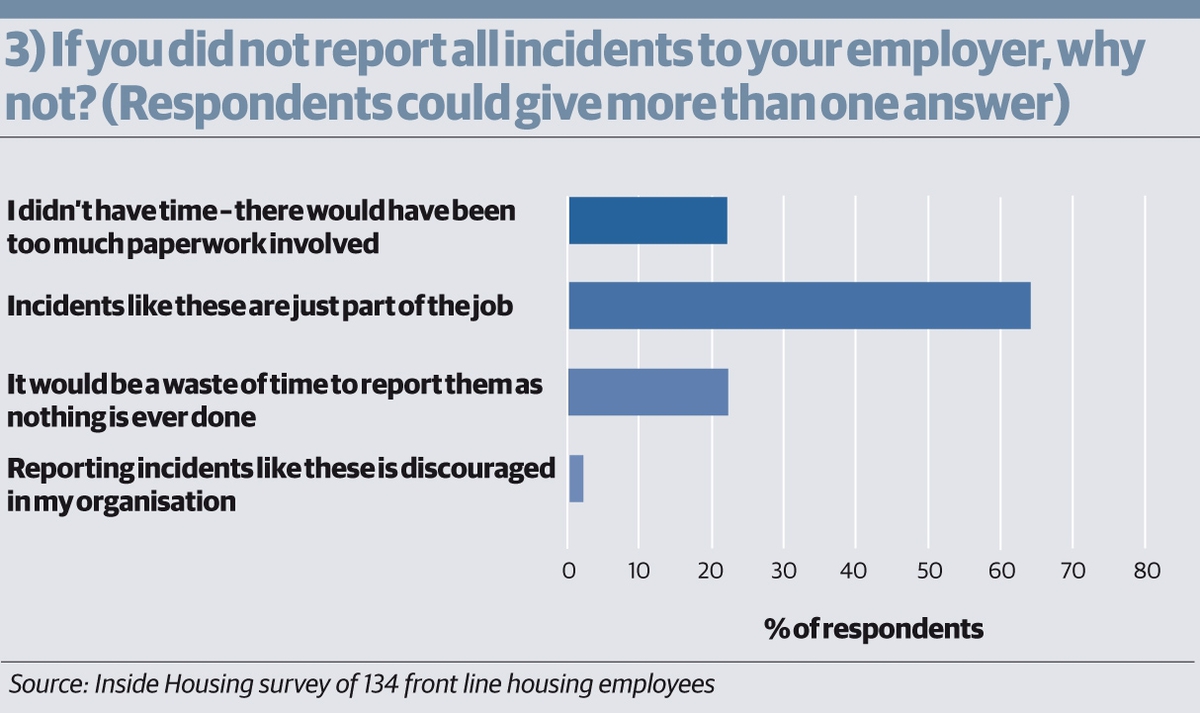
When asked why they have not logged all attacks to their employer, nearly two thirds of the 38 per cent of respondents who admit they haven’t recorded every single occurrence say it’s because assaults are ‘just part of the job’.
Andrew Griffiths, health and safety manager at 26,000-home housing association Bromford, believes this attitude can prevent organisations identifying and addressing problems. ‘We regularly remind colleagues to report incidents, especially minor ones, to ensure records are accurate if ever any such incidents need to be used to help manage any ASB cases or breaches of tenancy,’ he says.
Lincolnshire-based 8,200-home Shoreline Housing ran a campaign to encourage workers to report incidents throughout the 2010/11 financial year. It put up posters, sent emails and ran articles in its employee newsletter and on the intranet stressing how important it is that every single incident is reported to HR and its health and safety manager.
The organisation’s efforts paid off - ‘It’s evident in the figures,’ says a spokesperson. Ten verbal assaults were reported by Shoreline’s staff in 2010, rising to 37 in 2011.
In many organisations, however, such a campaign would probably only have a limited impact on the number of recorded assaults. Nearly a quarter of those who confessed in our survey that they don’t log all the assaults they’ve experienced say that they ‘do not have time’. There is ‘too much paperwork involved’, they state.
‘If I formally reported every time I am verbally assaulted it would be the only thing I did all day,’ says one officer working in the north west.
John Gray, housing association branch secretary at public sector union Unison says that given how ‘overworked and pressurised’ many front line housing employees feel, it’s ‘no wonder they do not report incidents of verbal abuse’. However, he stresses the importance of recording such attacks. ‘Verbal assaults can be really nasty,’ he says. ‘Year in, year out, people can’t take it.’
Some local authorities that responded to our FOI request do not record verbal assaults. Maidstone Council, for example, only records physical assaults, as does Southend.

Others, such as Sandwell Homes, take verbal attacks seriously. The ALMO, which manages 29,000 homes on behalf of Sandwell Council, goes a step further than most. It encourages employees to define the type of verbal assault that has taken place by breaking incidents into two categories: ‘verbal abuse’, which includes foul, offensive or aggressive language, racist and sexist insults; and ‘threat of violence’, which includes a threat of injury to an employee or their family.
Our findings reveal wide disparities between the number of assaults reported by similar organisations. The number of assaults reported by the UK’s largest stock-owning local authority, Birmingham Council, for example, was, relatively speaking, very low - it owns 69,000 homes and recorded 23 assaults in total last year. Meanwhile, ALMO Sheffield Homes, which manages 41,712 properties on behalf of Sheffield Council, recorded 135 incidents over the same time period.
It appears that high numbers of incidents may be a reflection of the emphasis an organisation places on reporting, rather than its efforts to protect its front line employees or the actions of tenants.
Appropriate action
Of course, reporting assaults is one thing - taking action against perpetrators is another. Our survey of housing workers revealed that they are most satisfied when their employer responds to incidents in a proportionate way.
Sometimes they’re happy when a letter is sent out stating that an individual’s behaviour will not be tolerated. In other instances they’re content when a tenant’s actions are flagged up on an internal computer system, meaning staff will not be sent to a particular property alone.
However, in some circumstances this course of action is ‘feeble’, states one respondent. Where cases are serious, employees want greater protection - for example, one housing officer who was verbally assaulted in the reception area of their organisation was happy when an injunction was taken out which prevented the tenant involved from entering the building.
The bad news is that 22 per cent of survey respondents who have not reported all assaults say that the reason they’ve not done so is because ‘it would be a waste of time’.
One London caretaker says their organisation ‘just shrugs off’ incidents that take place, while an ASB officer in the west midlands says their employer does not deal with reports quickly enough. ‘This frustrates me as it makes me feel that threats to staff are not taken seriously,’ they say.
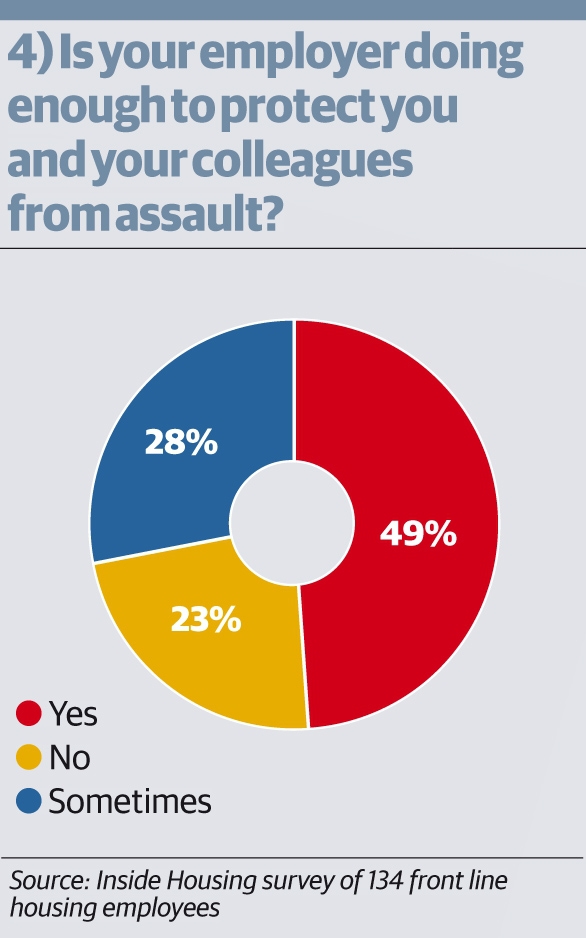
Indeed, just over half of all survey respondents believe their employer does not always do enough to protect its workers from assault.
One housing manager working in the capital says there is ‘complacency’ within their organisation. ‘It is not about wrapping people in cotton wool, but having some sensible precautions in place,’ they state.
A neighbourhood officer working in the north west believes that more training on lone working and personal safety should be given, while others want panic alarms and more advanced lone worker systems.
Linda Craig, director of the Suzy Lamplugh Trust, an organisation that specialises in loan worker safety, says the most important thing landlords can do is a risk assessment, and ‘have lone worker policies in place that have been done in consultation with staff’.
‘I realise that reporting systems are cumbersome,’ she adds, ‘but there should be a zero tolerance message on this that comes right down from the chief executive.’
If ever there was a time that front line workers need the support of well thought out procedures, it’s now. More than 90 per cent of respondents work on their own at least some of the time, and nearly 60 per cent believe they are more likely to operate alone more often as a result of cuts to staff numbers within their organisation. Approaching two thirds of these feel this puts them at more risk of being a victim of assault.
Under pressure
Staff numbers have been slashed just as the risk of aggression has increased, as a result of the financial pressures on tenants. Members of 36,000-home housing association Orbit’s income teams report a rise in the number of residents threatening to commit suicide due to the problems they are facing.
‘This is obviously very difficult for staff to deal with and is an indicator of the increasing strain many people are finding themselves under due to financial issues,’ says a spokesperson.
As if housing’s front line workers aren’t already being asked to deal with enough, the government’s welfare reforms will have ‘unintended consequences’, believes Andrew Orrey, chief executive of 10,000-home North Lincolnshire Homes.
‘It will be housing officers on the front line asking tenants for cash for things like the so-called “bedroom tax”,’ he says, referring to the policy coming into force from next April, under which social tenants will be docked an average of £13 per week for a spare room. ‘They will know certain customers cannot afford to lose that amount of money every week, but will still be the ones on the doorstep effectively enforcing the government’s plans.’
A neighbourhood officer working in the north east, who wishes to remain anonymous, says around 80 per cent of tenants living in his 130-home patch will be affected by universal credit when it is introduced next year. This will mean their benefits are paid directly to them instead of their landlord, and he’s concerned that many will fall into rent arrears.
‘Tenants will be forced to choose between eating, paying other debts and paying their rent,’ he says, adding that it will be part of his job to address rising arrears.
An estate manager in east London says although she does not ‘personally agree’ with the government’s welfare reforms, she will be ‘the person who has to administer them’.
‘The benefit changes will put additional strain on many tenants who may vent their frustrations on estate-based staff,’ she adds.
‘There will be more evictions,’ states Unison’s Mr Gray. ‘People who have lived all their lives in their homes, and their communities, are not going to like the fact they are being threatened with eviction - and they won’t blame the coalition, they’ll blame the infantry.’
The housing professionals who completed our survey demonstrated that despite the abuse they face on a daily basis, they’re committed to their job and to serving tenants. But if they find themselves putting their safety at risk performing a role they do not necessarily agree with, will they continue to dismiss verbal or physical violence as a mere occupational hazards?
A small minority of survey respondents had not been the victim assault since the beginning of 2009. ‘I’ve had a few close calls,’ states one London-based housing officer. The question now has to be: will existing staff think they are pushing their luck and start to seek alternative roles at a time when their experience is more vital than ever?
In numbers
64% of survey respondents who do not report all assaults say incidents are ‘just part of the job’
84% of survey respondents have been verbally assaulted
38% of survey respondents who have been assaulted did not report all incidents to their employer
51% of survey respondents believe their employer is not always doing enough to protect them from assault
8% of survey respondents have had a weapon used against them
1% of survey respondents have been sexually assaulted




Related stories