Belfast: Data guides planning, but it is important to maintain the consent of residents for the changes that are undertaken
Through the Belfast Agenda community plan, the city is taking a holistic approach to tackling climate change


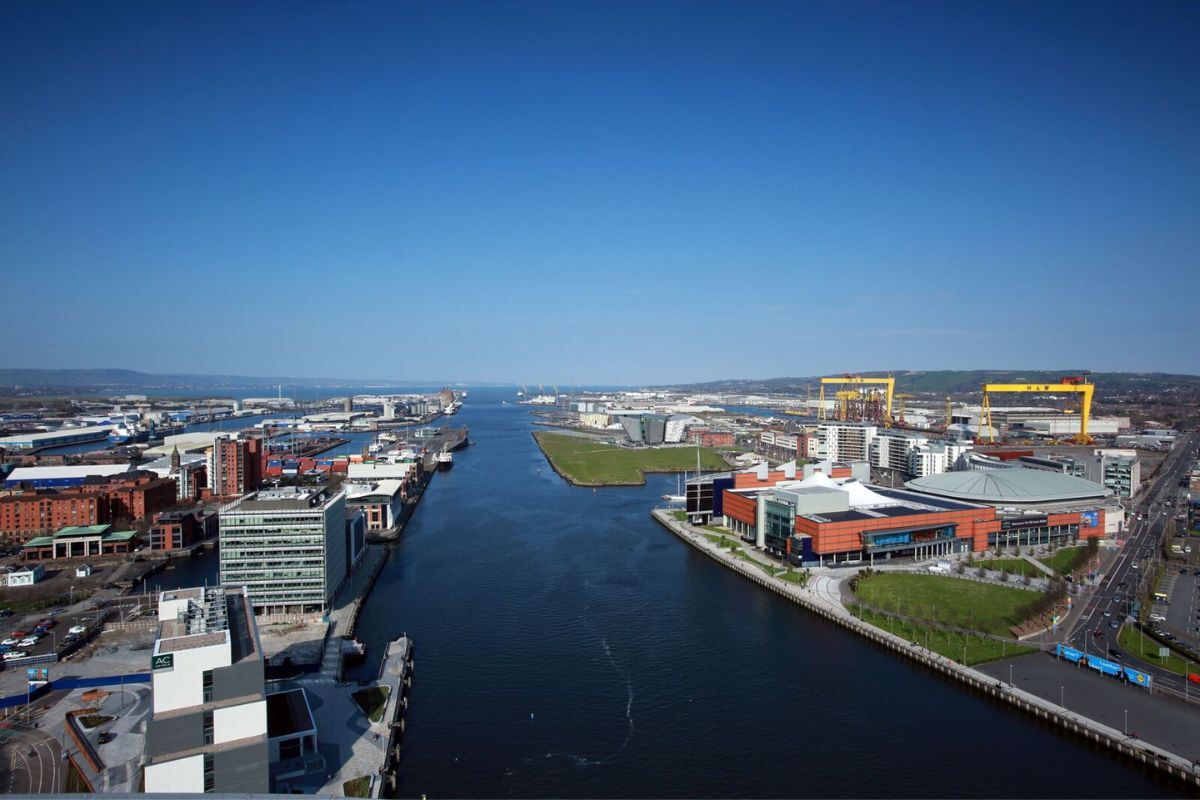 Through the Belfast Agenda community plan, the city is taking a holistic approach to tackling climate change #UKhousing
Go back to the Cities Encyclopaedia
The Belfast Agenda is a community plan that sets out the approach of the city and its community partners – including Belfast City Council, Belfast Health and Social Care Trust, the Northern Ireland Housing Executive, the CBI, Queen’s University and Ulster University – between 2024-28.
It states that, by 2035, Belfast will be a re-imagined and resurgent city defined by being a great place to live and work for everyone. At the core of this will be an emphasis on how the city tackles climate change. One of the city’s aims is to reduce its carbon emissions by 66% by 2025 and 80% by 2030, compared with 2005 levels.
The city is taking a holistic approach. The five core themes of the agenda link the impact on people and communities, the economy, the evolution of place and respecting the planet while making sure Belfast remains a compassionate city.
Read more


Belfast City Council is driven by an ambition to create a sustainable, nature-positive city. Its action plans focus on re-naturing and increasing resilience to climate change by creating a sustainable circular economy and innovating to meet net zero. This plan is built on the five foundations of re-naturing the city, leaving no one behind, building city resilience, greening the economy and sustainable urbanisation.
We sat down with Debbie Caldwell, climate commissioner, and Brenda Roddy, climate change project officer and lead on retrofit and zero-emission transport programmes, to understand more about at Belfast City Council’s work and progress to date.
Data is the key
Data is at the centre of their approach, to build a detailed understanding of the city, its infrastructure and demographic profile. Plans for a decarbonised future will be based on the production of a local area energy plan (LAEP). This is a bottom-up, data-driven, whole-system approach to delivering net zero within a particular location. Whole-system planning means all parts of the energy system are mapped, including supply and demand characteristics, transport, buildings, local industry and the environment. The aim of such an approach is to identify and outline the most cost-effective way for a local area to decarbonise and to set out an action plan for implementation.
“We will also use the plan to attract private-sector finance to deliver the projects”
“Producing the plan has really strengthened our evidence base, and, as a relatively new team, it is important that we have a big focus on data,” says Ms Caldwell. The plan builds on the city’s carbon roadmap developed in 2020, which identified that the majority of Belfast’s Scope 1 and 2 emissions were concentrated in the built environment and transport. The roadmap provided science-based emission-reduction targets which have been formally adopted by the city: a 66% reduction by 2025, 80% by 2030 and 100% by 2050.
Ms Caldwell says the LAEP used detailed modelling of the energy system and engagement with key stakeholders to identify five priority projects to enable the city to decarbonise. The priority projects were selected on the basis of being cost effective as well as creating multiple benefits for residents.
“We will also use the plan to attract private-sector finance to deliver the projects, and engage the market to help us to design the most appropriate and effective delivery models, based on robust data,” Ms Caldwell adds.

Start of the journey
Ms Roddy recognises that while the city is still at the beginning of its decarbonisation journey, “the appetite to engage is huge, but we recognise the challenge is how you take that simply beyond talking about change”. This insight mirrors much of the wider net-zero debate. Polling consistently shows that, when asked, people recognise the importance of dealing with climate change and they are keen to see action, but when it comes to personal actions, it is harder for them to commit fully.
Ms Roddy notes the scale of the challenge to retrofit the city’s housing stock and the pressure that puts upon the recruitment of labour to deliver it. “We have to recognise this is an ageing industry, and it is proving hard to get new people into the sector. There is a natural replacement cycle we are managing and, like other local authorities, we face similar challenges. In Northern Ireland, we have a particular challenge, with talent looking also to the UK and the Republic of Ireland for career prospects and opportunities.”
The city and its infrastructure, though, are an asset. “We are looking to attract more people to live in the city centre. This means increasing connectivity,” says Ms Caldwell. She recognises this will require investment in more services, but it will be built on Belfast’s public transport system, which is decarbonising fast. Around half of the city’s buses have already been converted to electric, hybrid or hydrogen, and the fleet will be net zero by 2050. More than 200 vehicles, including bin lorries and street sweepers, are now being powered by vegetable oil, Belfast City Council has said. This represents almost 50% of the council’s heavy-goods vehicle fleet.
The biggest challenge is to convince people to switch to public transport, as Belfast has a long history of high car dependence. This points to a behaviour-change challenge. The council is seeking to increase the number of pedestrianised areas in the city centre and collaborate with other stakeholders to encourage more people out of their cars.
This article was originally published in April 2024
Sign up to Inside Housing’s Sustainability newsletter
Sign up to Inside Housing’s weekly Sustainability newsletter, featuring our in-depth coverage of the sector’s journey to delivering net zero.
Already have an account? Click here to manage your newsletters.
Related stories




CPD webinar on demand: Project management and data – a recipe for warm homes success?SPONSORED ARTICLE