Building safety round-up: April 2026
A round-up of the key news stories, guidance documents and new thinking for those involved in building safety issues, gathered by Peter Apps


 Building safety round-up: April 2026 #UKhousingA round-up of the key news stories, guidance documents and new thinking for those involved in building safety issues, gathered by Peter Apps #UKhousing
News
-
England’s Building Safety Regulator (BSR) has set out its strategic plan for 2026-27. The plan makes continued improvement in its operation and processes the number one priority, following widespread criticism for the delays imposed by the Gateway process last year.
-
The plan followed the latest performance data from the BSR, which showed that its backlog of legacy cases for new build projects had been reduced to two, down from 91 in October. This does not include 13 legacy cases with significant technical challenges, which are being managed separately as complex cases. In total, across the past 12 weeks the regulator received 71 new cases and decided 68 (including 22 legacy cases), of which 61% were approvals. The average approval time was 22 weeks for regular cases and 36 weeks for complex cases.
-
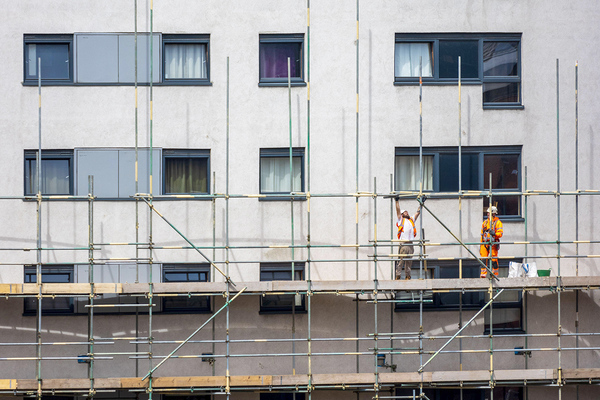
The BSR has also published a plan to reduce delays on cases involving external remediation, which will involve a dedicated taskforce – similar to the team that has tackled legacy new build issues – and a recruitment drive to reduce caseloads. Inside Housing has looked at the plan in detail here.
Read more



- As part of this plan, the government is seeking to remove some more minor work from the oversight of the BSR, with a consultation seeking views on changes to how work is defined and what sort of work might be suitable for a competent persons scheme in the future. The Fire Protection Association, which is funded by the insurance industry, has warned against existing plans to reduce oversight of fibre optic and communication cabling work.
-
In a ruling described as “landmark” by lawyers, the Technology and Construction Court this month ordered Ardmore Group, the parent company of the lead contractor on Portsmouth’s Admiralty Quarter development, to pay a £14.9m Building Liability Order under the act.
The ruling was said to have extended future building safety liabilities beyond insolvent contractors, and means other companies within the same group could be held liable.
-
The government has made £62m of funding available to replace ‘waking watch’ systems with fire alarms in buildings with major fire safety issues that undermine reliance on a ‘stay put’ strategy.
-
A care home in Dorset has been fined £70,000 for failings identified after the death of a vulnerable resident. Portelet Manor in Boscombe was prosecuted by Dorset and Wiltshire Fire and Rescue Service for a failure “to ensure appropriate fire safety arrangements were in place”. It followed the death of a resident who died after sustaining injuries in the smoking area in June 2023.
-
The House of Lords has passed a law that guarantees funding for a memorial to those who lost their lives in the Grenfell Tower fire in 2017. During the debate Lord Garnier, a former solicitor general, called for tougher laws on corporate crime.
-
Dr Barbara Lane and Dr Hywel Davies have been appointed as chair and deputy chair respectively of the Building Advisory Committee, which will assist the Building Safety Regulator in addressing new and emerging risks across the built environment, through expert advice and strategic guidance. Dr Lane, a fellow at engineering firm Arup, served as an expert witness at the Grenfell Tower Inquiry. Dr Davies is currently head of technical insight at the Chartered Association of Building Engineers.
-
Kingston upon Thames Council in west London has approved an additional £2.9m to complete fire safety works – with 935 actions from fire risk assessments outstanding.
-
At the start of the month, Reform UK’s housing spokesperson Simon Dudley was sacked following comments about the Grenfell Tower fire that he made in an Inside Housing interview.
-
A consultation on product regulation and the fire safety of domestic upholstered furniture has opened. Furniture can have a major impact on fire deaths, particularly through the production of toxic smoke.
-
The government of Victoria, Australia, has introduced a law that will wrap up the state’s building remediation taskforce, Cladding Safety Victoria (CSV). The taskforce went through a process of identifying and then managing remediation on higher-risk buildings in the state. It identified 1,600 buildings, with work now complete on 99% of them.
Remaining functions will be transferred to the state’s existing building regulator and a levy exerted on new building work will be lowered.
“CSV’s groundbreaking approach to identifying, assessing, classifying and treating combustible cladding risk has saved lives, and it has saved building owners hundreds of millions of dollars. At the conclusion of its programme of work, CSV will have improved building safety for all of us across Victoria,” said the legislative member introducing the bill.
- An inquiry into the devastating Wang Fuk apartment complex fire in Hong Kong has uncovered important evidence – including that the building’s fire alarm had been turned off for around eight months before the blaze in November last year. You can read more here.
Guidance
-
The BSR has published guidance on applying for building control approval for a higher-risk building, which is available here.
-
The Industry Competence Committee has developed a set of ‘principles for informed clients’ to help clients on construction projects contribute to making buildings safer and improve governance and culture. The principles are now subject to consultation, which is available here.
-
After the devastating fire in Glasgow at the historic building in Union Street, the safety reporting service for the construction sector has produced a report on the risk to historic buildings from fire. It discusses how historic buildings were constructed using materials and techniques that differ significantly from those used in modern construction, with major consequences for fire safety.
These include timber floor structures; hidden voids within floors, walls and roofs; large staircases or vertical shafts; and limited separation between occupancies. The result can be a fire that spreads much more rapidly and causes a much more catastrophic loss to the building.
Sign up to Inside Housing’s Building and Fire Safety newsletter
Sign up to Inside Housing’s fortnightly Building and Fire Safety newsletter, now including a monthly update on building safety from Inside Housing’s contributing editor Peter Apps.
Already have an account? Click here to manage your newsletters.
Related stories