You are viewing 1 of your 1 free articles
Exclusive interview with Reform UK’s housing spokesperson Simon Dudley
What direction will Reform UK take its housing policy? Jess McCabe meets Simon Dudley, who was appointed as Reform UK’s housing spokesperson last month, to find out his views on everything from development to post-Grenfell regulations and who should be eligible for social housing. It was an interview that had a big impact


 First interview with Simon Dudley as Reform UK’s housing spokesperson #UKhousingJess McCabe meets Simon Dudley, Reform UK’s new housing spokesperson, to find out his views on development, Grenfell regulations and who should be eligible for social housing #UKhousing
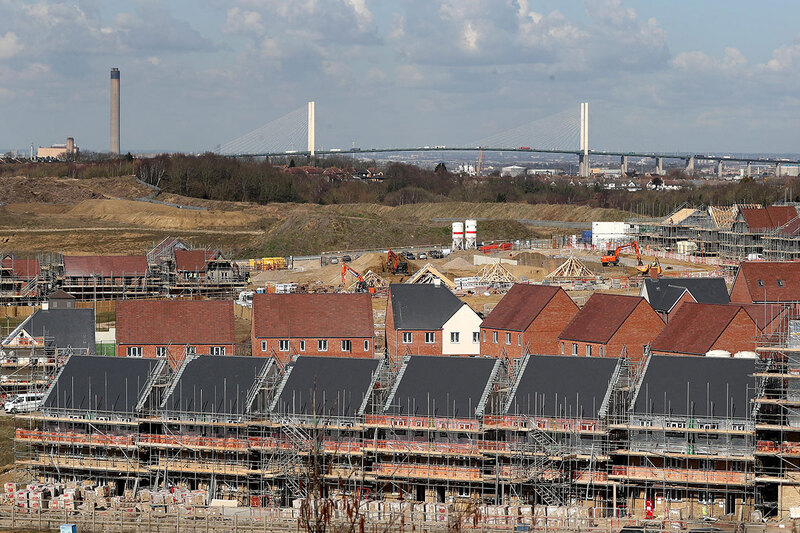
The last time Inside Housing interviewed Simon Dudley was five years ago, when he was chair of the Ebbsfleet Development Corporation, and we spent 15 minutes with him.
Now, Mr Dudley has a new job – housing and infrastructure spokesperson at Reform UK – and we’ve been given half an hour.
We’ve come to Reform’s headquarters in Millbank Tower in London for the interview. GB News is playing on the television in the waiting room. Each of the meeting rooms have names like ‘prosperity’ and ‘liberty’, illustrated with little photos such as a Union Jack flag billowing in the breeze.
I’m ushered into one of these meeting rooms and as we sit down, Mr Dudley points out the window at the dramatic view of the Houses of Parliament glittering in the sun. He comments jocularly that the Palace of Westminster is going to see a lot of changes in 2029 – the most likely year for the next general election.
Polls on voting intention if there was a general election tomorrow have for months placed Nigel Farage’s party ahead of both Labour and the Conservatives. In six weeks, Reform’s popularity will be tested in the ballot box, with local elections across England and parliamentary elections in Scotland and Wales.
“We’re developing a plan very quickly,” Mr Dudley begins. “We’re making sure that our policy offer and our ability to implement that is ready when people go and face the country.”
Read more

Even with the general election likely three years away, this makes it an urgent proposition for the sector to find out what the party’s policies might be on housing and, if possible, influence them.
Mr Dudley announced he was joining Reform in February 2026, and was appointed housing spokesperson by 6 March. In a column in The Telegraph, Mr Dudley wrote that he was joining the party because “after a career spent getting good-quality homes built, I do not trust the Tories – or Labour – to reverse the problems they helped create”.
Mr Dudley is known to the sector – as mentioned before, he spent four years chairing the development corporation for the Ebbsfleet new town. He was also on the board of Homes England and chaired the body from 2019 to 2021. As Conservative leader of the Royal Borough of Windsor and Maidenhead from 2016 to 2019, he built a YIMBY-ish reputation.
But Reform’s statements on housing so far have been short on detail. So, here we are in Millbank trying to find out more.
Housing issues and the hot topic
It’s a short interview, and Inside Housing is whisked in and out. But in that half an hour, we cover building safety regulations, development, Help to Buy, the Right to Buy, stamp duty, social housing allocations and whether Reform would abolish Homes England.
Mr Dudley also brings us a number times to another housing topic he seems keen to talk about: the impact of immigration on housing demand.
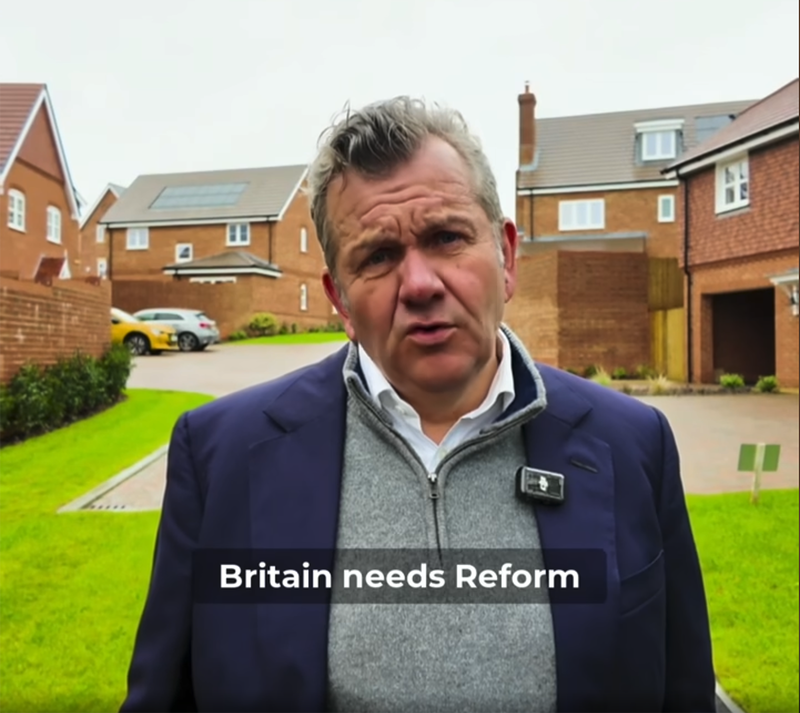
Mr Dudley announced he was joining Reform in a video posted on LinkedIn and X that showed him talking from a new build estate in his home patch of Maidenhead. The video was also cut with an image showing an anonymous group of men walking in a group. Over this scene, he criticises the former Conservative government for “failing to build the number of new homes Britain needs and letting record numbers of people in from abroad”.
He got a mixed response from both supporters and the opposition. One architect commented: “I don’t do politics on this platform, but as a refugee and foreigner who has spent his career helping people and delivering affordable homes, I can only say I am horrified and that you blame me and others for this – shameful!”
He burned some bridges in his former party as well. Sally Coneron, Conservative group leader at Windsor and Maidenhead Council, wrote in a letter to the local paper: “On behalf of Conservative councillors and members across the royal borough, I can only echo [Conservative Party leader] Kemi Badenoch’s words, ‘The Conservatives are learning from the mistakes of the past’ and [Mr Dudley is] Nigel’s problem now.”
Even before Mr Dudley’s appointment, Reform leaders had been talking about the need for housebuilding. At a press conference a few months ago, Mr Farage said: “A move towards net zero migration would ease pressure on rents; it would ease pressure on house price affordability. And we will commit to the biggest building programme of genuinely affordable housing that this country has ever seen. Our young people deserve nothing less.”
Richard Tice, deputy leader of Reform, under whom Mr Dudley works, took out an advert recently calling for the creation of a sovereign wealth fund for the UK. This would be funded by combining the assets of local government pension schemes, and would invest in housing and infrastructure.
Build, baby, build?
While preparing for the interview, one sector leader challenged me to ask Mr Dudley how he would solve the housing crisis. However, when it comes to enthusiasm for housebuilding, there seems to be little difference between Reform and the other parties: all agree the country needs to build far more homes.
Mr Dudley is an advisor to the Build for Britain thinktank, which describes itself as centre-right. It even sells ‘build, baby, build’ hats, similar to those famously sported and handed out by Steve Reed, Labour’s housing secretary. Mr Reed’s caps are red, while Build for Britain’s are blue.
Meanwhile, Build for Britain’s manifesto calls for the abolition of stamp duty – which is now a policy of the Conservative Party. (Mr Dudley said during our interview he would support this policy and doesn’t believe it would be as expensive as many predict, but this is not an official position of Reform.)
“Many, many more people die on the roads driving cars, but we’re not making cars illegal, so why are we stopping houses being built?”
“The regulations have meant that things are not viable, ie the private sector can’t make profit, and there’s nothing wrong with profit. You make profit, you pay tax, you employ people,” Mr Dudley says. “We need to simplify the planning system in certain areas to facilitate development, particularly in our cities and major conurbations.”
Mr Dudley wants to spur development by cutting regulation and planning rules. One senior leader told Inside Housing: “He feels that more swashbuckling approach will be able to get us building the houses that we very much need, and 300,000 [homes a year] isn’t a big enough target and actually we should be able to do more.”
Regulation ‘not working’
He volunteers the example of the building safety regulations introduced after the Grenfell Tower tragedy as “regulation which is not working”. Problems of delays at the Building Safety Regulator are well documented, and there is cross-party interest in ensuring the regulator is working properly.
Still, on the day of our interview, the Regulator of Social Housing published statistics showing that 1,924 social housing blocks taller than 11 metres still have “life-critical fire safety” defects relating to their exterior walls.
I ask, was Grenfell not an awful warning about insufficient regulation?
“That was a tragedy. It was a failure,” Mr Dudley says. But he doesn’t believe the current regulatory regime is proportionate. “Sadly, you know, everyone dies in the end. It’s just how you go, right?” he says.
“Extracting Grenfell from the statistics, actually people dying in house fires is rare,” he argues. “Many, many more people die on the roads driving cars, but we’re not making cars illegal, so why are we stopping houses being built?
“Think about all the human suffering of not having a home, not being able to have children, being stuck with your parents, in your childhood bedroom,” he continues. “You can’t stop tragic things happening. You can try to minimise excesses, but bad things do happen.” (Update, 02.04.26: These comments proved controversial, with Nigel Farage describing them as “deeply inappropriate”. He said that Mr Dudley had been removed from his role. Posting on X this morning, Mr Dudley said: “In no shape or form am I belittling that disaster [Grenfell] or the huge loss of life. It must never happen again.”)
The current regulation and regulator came out of the Grenfell Tower Inquiry and were formed under the auspices of his erstwhile colleagues in the Conservative Party: Michael Gove as housing secretary and Theresa May as prime minister. Mr Dudley calls them “decent people”, but clearly sees the approach as misguided.
He is far from alone in thinking that the Building Safety Regulator may need further adjustments, or in being concerned about the impact on development. The question is how that is handled.
We put Mr Dudley’s comment to Eddie Hughes, who was Conservative minister for rough sleeping and homelessness from 2021 to 2022. He later tells Inside Housing: “I’ve been into that building [Grenfell Tower], had a floor-by-floor tour, I’ve sat around the table with the bereaved and survivors, and I think you need kind of exposure to that to understand the delicacy of the topic. However, we still need to build things and we need them to be safe.”
Back in Reform HQ, Mr Dudley says: “The impact of poor regulation is to stop housebuilding in one of the world’s capitals. So the pendulum has just swung too far the wrong way.
“And, frankly, for people who are the architects of things, it’s very difficult for them to put them right. And Reform is not the architect of so many of these failures which our country has now. We will put it right, because we’re not emotionally connected with them. They’re not things that we created. We will fix them.”
What would a Reform fix look like? Mr Dudley responds with a question rather than an answer: “Is it capable of being fixed?” For him, this would mean reform of the regulator so “buildings can proceed and capital can be deployed into a sector in a fast way”. On the other hand, he posits it could be “so rotten that it needs to be changed fundamentally”.
‘Pro-affordable housing’ stance
Given Mr Dudley’s role at Ebbsfleet, what does he think of the government’s New Towns Programme?
“I think they are part of the solution, but only part of it really,” Mr Dudley says. “They take a lot of time. They need a lot of public money, but you know, we’re looking at huge areas like London, where there’s virtually no development going on.”
“Let’s build hundreds of thousands of homes in London, Sadiq Khan,” he says. (He is not a fan of the London mayor. On the Mod Cons Podcast earlier this year, Mr Dudley called Sir Sadiq Khan a “pest”). “This is where the people should be looking, not at seven or eight new towns, which are going to take 30 years to come to fruition.”
“I think [new towns] are part of the solution, but only part of it really”
Reform’s housing spokesperson is pro-housing, but does that make him pro-social housing? Mr Dudley says: “I think we should build lots and lots more homes, yeah, and that will make homes more affordable.”
He does acknowledge the need to build affordable homes, particularly for retirees who haven’t managed to buy a property. But when I ask if Reform would continue the Social and Affordable Homes Programme, which at a duration of 10 years is meant to outlive the current parliament, he doesn’t commit one way or the other.
“I am pro-affordable housing,” he says. “Whether the way that the affordable homes programme – because, remember, I used to chair Homes England – whether that is the right way to do it, or whether there are other ways and you can save some money there. I think we just need to work through all the numbers.”
Quangos to be scrapped?
Despite his time chairing Homes England, Mr Dudley indicates that the agency might be cut or changed under Reform. The body is “good at aggregating land assembly” and “has a lot of very talented people”. On the other hand, he calls it “a big fat quango” and notes it “has ‘X’ number of people earning, you know, over £100,000 a year”.
Instead, he questions whether “it will be more appropriate for part of that business to be disaggregated and put into devolved administrations, where it’s close to locally elected people with a mandate”.
Natural England is another body that could be up for the chop under Reform – Mr Dudley criticises chair Dr Tony Juniper as not having a pro-development stance.
“I think we should have a very close look at a number of quangos about the loss of accountability and control,” he says. “When people vote for politicians, they expect politicians to do stuff. But, actually, if the power has been handed over to independent boards, then the politicians haven’t got the power.”
How Reform funds affordable homes could also be different. He brings up Mr Tice’s idea of a sovereign wealth fund, stocked with the capital from local government pension funds. “You aggregate that with grant income to buy down that, and you can create a lot more affordable housing, genuinely affordable housing,” Mr Dudley says.
Immigration and education
Then he brings the conversation back to immigration. “We need to stop turbo-charging demand – by that…” he pauses. “I know if you’ve got net legal migration running at 750,000 a year, whatever the number is, you know, a multiple of times more than the Conservatives promised it was going to be – but lied. They lied.
“Their manifesto said we're going to do this. Then they went and proceeded to do absolutely the opposite to that.”
Net migration dropped sharply in 2025, to 204,000 from 649,000 the year before.
The linchpin of Reform’s proposals involve a ‘mass deportation bill’, building detention centres and up to five deportation flights a day. The party has suggested it would make payments to countries, including Afghanistan, as part of this policy.
Build for Britain’s manifesto includes a table that sets out the number of homes the UK needs to add in different immigration scenarios, running up to a net emigration of 150,000 people a year.
These policies are extremely controversial for reasons that go beyond housing policy.
However, the construction sector is particularly reliant on workers from outside the UK. Rico Wojtulewicz, head of policy and market insight at the National Federation of Builders, was quoted in The Telegraph earlier this year saying that under net zero migration, construction “would literally grind to a halt”.
Even on current projections, the UK might enter net emigration by the end of 2026. Modelling by the National Institute of Economic and Social Research found that net emigration could shrink the UK economy by 3.6% by 2040 and increase the deficit by £37bn. This could force the government to raise taxes. Contracting economies tend not to build swathes of homes.
But when I ask about this, Mr Dudley’s response is not about immigration policy, but about the birth rate. He points out that housing costs are taking up far too much of people’s income and making it extremely difficult to afford children. “I absolutely guarantee your live-birth rate will go up if you solve the housing crisis,” he says.
In the long run, Mr Dudley would want the construction sector to fill the skills gap by training unemployed young people in the UK, though he does admit there may need to be a transition arrangement with temporary migration to fill shortages.

“Why aren’t more people training in construction and having skills where you can have a very good job and earn very good money, and it’s not going to be replaced by AI over the course of the next decade,” Mr Dudley says. Tradespeople, he notes, are in demand and can set their own prices.
Mr Dudley went to John Lyons, a private school in north London, before his economic and social studies degree at the University of East Anglia and later the London Business School. The policy he is best known for, apart from housing, relates to education. While a local councillor, he co-founded Holyport College in Maidenhead.
Holyport was the UK’s first state boarding school, set up with Eton College as its educational sponsor. One of Mr Dudley’s four children attended Eton and his youngest attended Holyport, he has previously said.
Social housing allocation and homeownership
Previous comments by Reform figures suggest the party could look to restrict who is eligible for council housing. On 26 January, Mr Farage posted a video of himself on Facebook saying: “How can it be that somebody who enters our country illegally, having destroyed their identity documents, is a higher priority for housing than a former service man or woman who has fallen on hard times.”
On Newsnight in November, Zia Yusuf, then Reform’s head of policy and now spokesperson for home affairs, claimed that “the majority of social housing in London goes to foreign nationals”. This is incorrect: figures supplied by the G15, analysed by local news site On London, found that “17% of new social housing lets in London during 2024-25 went to foreign national lead tenants – significantly fewer than a majority”. Government statistics show that across England, this proportion is 11%.
When I ask Mr Dudley if Reform would change allocation policies, he gives a strong indication of the answer, replying: “You know there are certain people who should not be in this country, or should not have permanent right to be here. So you know that. You know, again, they should not be getting on to the housing list, not taking up our housing stock moving forward.”
“I think we should have a very close look at a number of quangos about the loss of accountability and control”
Coming to the end of our allotted time, I’m only able to fit in a couple more questions.
On stamp duty, Mr Dudley won’t promise that Reform would abolish it, as the Conservative Party has done. But he is obviously minded to, arguing that the costs to the Exchequer would be lower than feared because of the economic boost from more people moving.
He is in favour of a new round of Help to Buy, or something similar. “I want to see more people as owners. So it was very effective,” he says. The Telegraph recently reported that the Labour government is already looking at options to bring the policy back. Mr Dudley indicates that Robert Jenrick would need convincing. (Mr Jenrick will be best known to Inside Housing readers from his time as Conservative housing secretary from 2019 to 2021. He defected to Reform in January and was appointed treasury spokesperson.) But Mr Dudley says: “I would definitely look at that kind of intervention again.”
“I strongly believe that house builders who access the Help to Buy programme should pay to access it, because it’s making their sales easier,” he adds. Unfortunately there isn’t time in the interview for a back and forth on how that would work.
The Right to Buy is also “something which has to be looked at as well”, he says.
Inside Housing struggled to find sector figures who were happy to talk about Reform’s housing policy on the record. However, we understand that sector bodies and housing associations have been engaging with the party behind the scenes, hoping to influence its developing policies.
Later that day, Mr Dudley was spotted in the House of Lords at the launch of the UK Housing Review by the Chartered Institute of Housing (CIH). He had been invited by Mr Hughes as soon as his new position was announced. Former minister Mr Hughes, who has remained involved in the housing and homelessness sectors, also met with Ben Bradley, Reform’s head of local government delivery.
Mr Hughes tells Inside Housing: “I was very, very keen to get him [Mr Dudley] into that CIH event and introduce him to a few people who will now hopefully arrange meetings and talk to him, because it is important that during this formative period when they are putting together a team and focusing on policy that they they’re getting input from as broad a spectrum as possible.”
Mr Dudley later posted about the event on LinkedIn: “Lots of challenges but so much determination to fix things.”
Update: since this story was published, Simon Dudley has been sacked as Reform UK’s housing spokesperson
Other recent interviews with politicians
Scottish housing secretary: ‘We’ve been learning a lot from Homes England’
The Scottish government has announced that it will set up a national housing agency in the first year of the next parliament. Ellie Brown speaks to Màiri McAllan, the country’s housing secretary, about what the new agency could look like, what she says on calls with Steve Reed and what her plans are following the election this May
Paula Barker: how Labour can ‘get our sh*t together’ on homelessness
Paula Barker spent less than a year as shadow homelessness minister before Labour came to power. Now she is advocating for homelessness from the back benches. Katharine Swindells meets her in Westminster
Sir James Cleverly interview: regulation is ‘always the wrong answer’
Shadow housing secretary Sir James Cleverly shares his views on Grenfell, the Renters’ Rights Act and the Conservative Party’s pledge to end stamp duty. James Riding reports
Sign up to Inside Housing’s Best of In-Depth newsletter
Sign up to Inside Housing’s Best of In-Depth newsletter, a weekly compilation of our best features and comment.
Already have an account? Click here to manage your newsletters.
Related stories