You are viewing 1 of your 1 free articles
The times are changing: let’s look to research for understanding and opportunity
We are proud to sponsor Thinkhouse’s Early Career Researcher’s Prize, an opportunity to showcase work to a wide and influential audience, writes Bekah Ryder, research and insights manager at consultancy Altair



Bekah Ryder is research and insights manager at Altair
 We are proud to sponsor Thinkhouse’s Early Career Researcher’s Prize, an opportunity to showcase work to a wide and influential audience, writes Bekah Ryder, research and insights manager at Altair #UKhousing
The social housing sector reacted with jubilation to the Spending Review and the announcement of an additional £39bn over the next 10 years for the Social and Affordable Homes Programme (SAHP). There was also the announcement of £2.5bn in low-interest loans for social housing providers and a 10-year, Consumer Price Index + 1% rent settlement, as well as the consultation on rent convergence.
Alongside the focus on new supply and long-term financial certainty, the government has committed to funding some of the tough challenges in existing homes, such as building safety and decarbonisation.
In addition, £950m has been allocated to support local authorities in England to increase the supply of good-quality temporary accommodation.
Read more
Yet, even after publication of the government’s Delivering a decade of renewal for social and affordable housing policy paper, the details behind the Spending Review announcements remain scant.
We know that 60% of the SAHP will be for social rent and up to 30% of funding will be for London. But what will the average grant be per home and per tenure? Will the 10-year rent settlement give the sector the financial capacity to build these new homes as well as maintain and improve existing ones? How might rent convergence work and over what timescale?
Much of what has been announced, I would argue, wouldn’t have been possible without research to show the need. This ranges from charity Crisis and the National Housing Federation’s 2018 research on housing supply requirements for low-income or homeless households, to research by the G15 group of large London landlords on reintroducing rent convergence, and even research on the provision of floor coverings in social housing funded by the grant-making Longleigh Foundation and completed by Altair.
Research is central for evidencing and framing the needs of the sector.
“While the planned investment in social housing that has been announced is greater than in recent years, so too are the scale of the challenges we currently face”
While the planned investment in social housing that has been announced is greater than in recent years, so too are the scale of the challenges we currently face.
Temporary-accommodation usage is at a historic high and threatens to bankrupt council budgets, while housebuilding has slumped. Greenhouse gas emissions from domestic dwellings make a significant contribution to climate change. Our population is ageing rapidly, and the birth rate is declining, affecting the homes and support we need now and in the future. Many of us feel poorer and our public services are stretched, potentially changing what’s needed from housing providers.
In March, without much fanfare, the Ministry of Housing, Communities and Local Government published its areas of research interest. It’s an interesting reflection on what the current big housing challenges are, and the evidence we need to understand and drive activity.
There’s a focus on international learning, exemplary practice, cost effectiveness, capability and capacity, at-risk populations and life outcomes. It includes the impact of poor-quality housing; gaps between the designed and measured energy performance of buildings; productivity and workforce challenges in the construction sector; how housing policies can alleviate child poverty; and the most cost-effective ways of moving households out of temporary accommodation.
We are also awaiting the long-term housing strategy and cross-government homelessness strategy, both of which are likely to raise further questions for research.
There have been seismic shifts in the sector because of consumer regulation. This led to the tenant satisfaction measures and valuable research on the tenant voice, including the Tenants at the Table report by A Voice for Tenants, a steering group which aims to establish a national body for tenants, and Is There a Seat at the Table? Ethnic Minority Voices in Tenant Engagement, a report by Tpas associate and involved tenant Kai Jackson, Tpas and CaCHE (the UK Collaborative Centre for Housing Evidence).
With more regulatory change coming – around building safety, Awaab’s Law, decent homes, energy efficiency and consumer standards – research can help us answer questions about preparation, options, outcomes and effectiveness.
“With more regulatory change coming – around building safety, Awaab’s Law, decent homes, energy efficiency and consumer standards – research can help us answer questions about preparation, options, outcomes and effectiveness”
In times of uncertainty and transformation, research can help us examine our challenges and their scale, as well as barriers, opportunities, interventions and impacts.
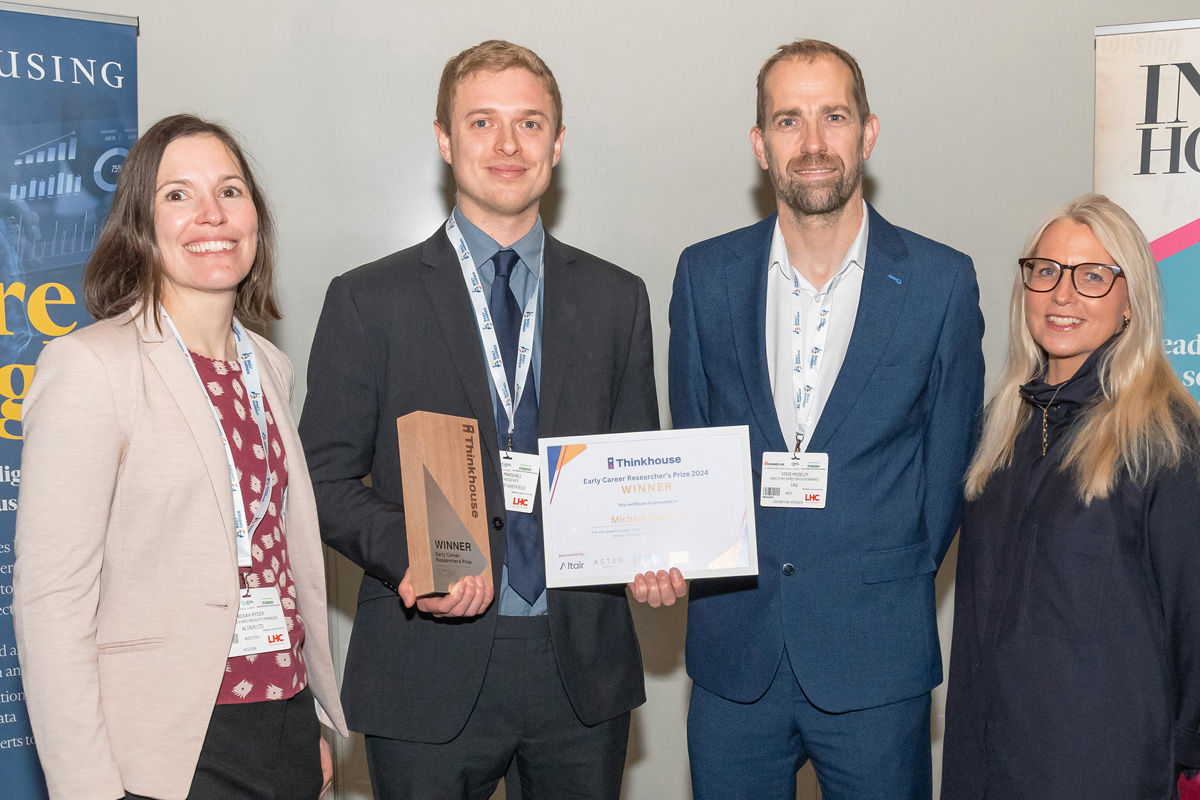
This is why Altair, alongside housing associations Aster Group and L&Q and Inside Housing, are delighted to sponsor Thinkhouse’s Early Career Researcher’s Prize. The prize, in its seventh year, is an opportunity for early-career researchers (those with up to eight years of experience) to showcase work to a wide and influential audience.
Submissions are judged by an esteemed panel of housing experts, including academics, senior professionals and those with lived experience. It creates an opportunity to share ideas with the sector. The winning paper will be published on the well-respected Thinkhouse repository of research on UK housing.
Interested? The deadline for submissions is Thursday, 25 September. For more details about how to apply, please visit Thinkhouse’s website. For more information about previous winners, read about them in Inside Housing and access their papers on Thinkhouse.
Submissions should match the broad interests of Thinkhouse, with policy publications that cover ways to increase the amount and quality of the UK’s housing stock and the related economic, social and community benefits of doing so, as well as international research with relevance to the UK.
We want to hear from those who are constantly curious – questioning approaches, testing and exploring the uncertain and the unknown. If that sounds like you, then we look forward to reading your paper in September.
Bekah Ryder, research and insights manager, Altair

Related stories