Lessons from Cambridge: delivering council housing at scale
Local authorities can embrace new delivery models, pursue intelligent densification and collaborate meaningfully with the private sector, writes John Mason, associate at Carter Jonas


 Local authorities can embrace new delivery models, pursue intelligent densification and collaborate meaningfully with the private sector, writes John Mason, associate at Carter Jonas #UKhousing
Not since the 1970s has Britain delivered in excess of 350,000 new homes — the level of annual housebuilding now targeted by the government. What is sometimes forgotten is how this figure was achieved.
Around 200,000 of those homes were delivered by the private sector, a level broadly consistent with what the market tends to produce in most economic cycles. The remaining 150,000 were built by councils. In other words, the last time the UK hit the numbers it needs today, it did so because local authorities were major house builders.
More than half a century later, the housing crisis facing cities such as Cambridge raises an urgent question: can councils once again play a decisive role in delivering homes at scale?
Read more
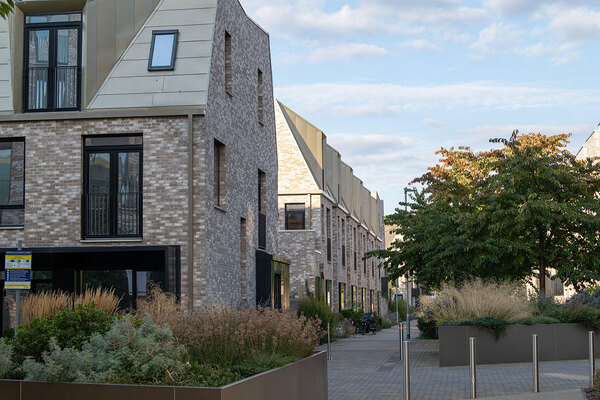


A project currently under construction in the Barnwell area of east Cambridge suggests the answer is ‘yes’ – if local authorities embrace new delivery models, pursue intelligent densification and collaborate meaningfully with the private sector.
Barnwell’s local centre has long been earmarked for development. Identified for regeneration in the 2006 local plan, the area suffered from ageing shops, tired residential blocks and a poor-quality public realm.
Progress was slow for many years, in part because large-scale urban renewal requires capacity, funding and technical expertise that most councils no longer hold in-house.
“This is council housing, but not as the post-war generation knew it”
This changed when Cambridge City Council, through its joint venture with The Hill Group – the Cambridge Investment Partnership (CIP) – committed to a comprehensive redevelopment strategy.
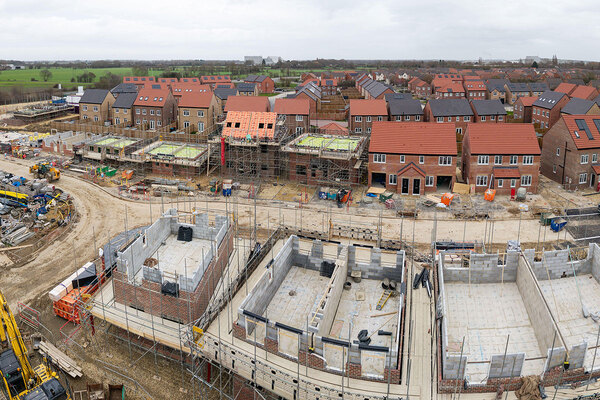
The result is ‘East Barnwell’: an estimated £50m scheme that delivers a vibrant new district centre of 120 new affordable council homes, as well as a community centre, library, preschool, café and commercial units. The buildings are knitted together with landscaped public spaces including a new central square.
The project has been built to stringent sustainability standards (the locally recommended Cam Standard) and includes air-source heat pumps, green roofs and solar panels, and a 20% biodiversity net gain – double the national statutory requirement.
This is council housing, but not as the post-war generation knew it. It is mixed use, sustainable, and designed around movement, community and well-being.
The East Barnwell scheme exemplifies a critical lesson for local authorities: partnerships can unlock delivery. CIP leverages the complementary strengths of the public and private sectors. The council brings democratic accountability, long-term stewardship and community trust. Hill contributes development, design and construction expertise.
The outcome is 23 different projects across the city, and delivery of 1,000 homes and counting, including more than 700 net new council homes. The sustained community engagement and close collaboration with the planning team means that schemes have consistently achieved planning permission on the first attempt.
Councils alone often lack the resources or risk appetite to undertake complex regeneration. Equally, market-driven development does not always have the access to land and does not always prioritise long-term social value.
At East Barnwell, the joint venture structure mitigates these weaknesses. The public sector sets the direction and owns the assets; the private sector ensures efficient, high-quality delivery. It is a hybrid approach, but one increasingly recognised as essential for meeting today’s housing needs.
“These schemes collectively demonstrate that, when equipped with the right tools, councils can again become engines of housing delivery”
National planning policy is clear: urban land must be optimised before green belt release is considered. This requires higher density development, especially in well-connected locations. But densification remains politically and socially challenging unless it is of a demonstrably high quality.
East Barnwell has increased the number of homes on the site from 18 to 120, all of them affordable, while improving open space, connectivity and the overall character of the area. This is possible because the scheme reorganises land intelligently, replacing poorly used spaces with a coherent layout anchored by new community facilities and public realm.
While tall buildings can be a sensitive issue in the historic city, the increase in height from two to six storeys was felt to be appropriate in creating a strong identity for the district centre, and providing a new landmark for the rest of the neighbourhood to coalesce around.
Cambridge’s acute growth pressures make this approach essential. With Cambridgeshire’s population forecast to grow by 17.9% between 2023 and 2041, large-scale growth cannot rely on the green belt alone. Well-planned urban intensification must form part of the solution, and East Barnwell provides a replicable model.
East Barnwell is not a one-off success. It forms part of a sustained council-led delivery pipeline. Through CIP, Cambridge has delivered hundreds of new affordable homes in recent years, with more under construction. These schemes collectively demonstrate that, when equipped with the right tools, councils can again become engines of housing delivery.
As planners debate the future of British housing policy – from the role of densification to the fate of the green gelt – projects like East Barnwell demonstrate that solutions already exist. Council housing can work. It has worked before, and with the right partnerships, it can help the country meet the ambitious housing targets it now faces.
John Mason, associate, Carter Jonas
Sign up to Inside Housing’s Development and Finance newsletter
Sign up to Inside Housing’s weekly Development and Finance newsletter, featuring a round-up of business, development and regeneration news and analysis.
Already have an account? Click here to manage your newsletters.
Related stories